Correlation Cycle, CorrelationAngle, Market State - John EhlersHot off the press, I present this "Correlation Cycle, CorrelationAngle, and Market State" multicator employing PSv4.0, originally formulated by Dr. John Ehlers for TASC - June 2020 Traders Tips. Basically it's an all-in-one combination of three Ehlers' indicators. This power packed triplet indicator, being less than a 100 line implementation at initial release, is a heavily modified version of the original indicator using novel techniques that surpass John Ehlers' original intended design.
This is also a profound script in numerous ways. First of all, these three indicators are directly from the illustrious mastermind himself Dr. John Ehlers. Secondarily, this is my "50th" script published on TV, which makes it even more significant. I'm especially proud of this script to "degrees" of imagination I once didn't know was theoretically possible in code. My intellect has once again been mathemagically unlocked pondering new innovations with this code revelation. Thirdly, this PSv4.0 script shows the empowering beauty and elegance of hacking the stock markets with TV's ultra utilitarian Pine Editor(PE) in a common browser! Some of you may be wondering if I worked on this for days... nope! This only took a few hours, followed by writing this description for another hour plus.
I have created many of Ehlers' indicators in PE, a few of which I have published in my profile, but I wanted to show how programming with Pine Script can be an artistic form of craftsmanship and poetry. None of this would be possible without the ingeniously minded Tradingview staff revolutionizing algorithmic trading at it's finest. If you should ever encounter them by chance, ponder humbly thanking these computing wizards for their diligence and dedication. They are providing, and shall award to us members, some of the most fascinating conceptualized tech imaginable in the coming future. I can assure you, much, much more is yet to be unveiled for us TV members/enthusiasts. Thank you TV and all you offer to this community.
As always, I have included advanced Pine programming techniques that conform to proper "Pine Etiquette" by example. There are so many Pine mastery techniques included, I don't have an abundance of time to elaborate on all of them. For those of you are code savvy, you may have notice I only used one "for" loop for increased server efficiency, instead of the two "for" loops in the original formulation. For those of you who are newcomers to Pine Script, this code release may also help you comprehend the immense "Power of Pine" by employing advanced programming techniques while exhibiting code utilization in a most effective manner. This is commonly what my dense intricate code looks like behind the veil. If you are wondering why there is hardly any notes, that's because the notation is primarily in the variable naming.
Features List Includes:
Dark Background - Easily disabled in indicator Settings->Style for "Light" charts or with Pine commenting
AND a few more... Why list them, when you have the source code!
The comments section below is solely just for commenting and other remarks, ideas, compliments, etc... regarding only this indicator, not others. When available time provides itself, I will consider your inquiries, thoughts, and concepts presented below in the comments section, should you have any questions or comments regarding this indicator. When my indicators achieve more prevalent use by TV members, I may implement more ideas when they present themselves as worthy additions. As always, "Like" it if you simply just like it with a proper thumbs up, and also return to my scripts list occasionally for additional postings. Have a profitable future everyone!
ابحث في النصوص البرمجية عن "Cycle"
Ehlers Autocorrelation Periodogram (EACP)# EACP: Ehlers Autocorrelation Periodogram
## Overview and Purpose
Developed by John F. Ehlers (Technical Analysis of Stocks & Commodities, Sep 2016), the Ehlers Autocorrelation Periodogram (EACP) estimates the dominant market cycle by projecting normalized autocorrelation coefficients onto Fourier basis functions. The indicator blends a roofing filter (high-pass + Super Smoother) with a compact periodogram, yielding low-latency dominant cycle detection suitable for adaptive trading systems. Compared with Hilbert-based methods, the autocorrelation approach resists aliasing and maintains stability in noisy price data.
EACP answers a central question in cycle analysis: “What period currently dominates the market?” It prioritizes spectral power concentration, enabling downstream tools (adaptive moving averages, oscillators) to adjust responsively without the lag present in sliding-window techniques.
## Core Concepts
* **Roofing Filter:** High-pass plus Super Smoother combination removes low-frequency drift while limiting aliasing.
* **Pearson Autocorrelation:** Computes normalized lag correlation to remove amplitude bias.
* **Fourier Projection:** Sums cosine and sine terms of autocorrelation to approximate spectral energy.
* **Gain Normalization:** Automatic gain control prevents stale peaks from dominating power estimates.
* **Warmup Compensation:** Exponential correction guarantees valid output from the very first bar.
## Implementation Notes
**This is not a strict implementation of the TASC September 2016 specification.** It is a more advanced evolution combining the core 2016 concept with techniques Ehlers introduced later. The fundamental Wiener-Khinchin theorem (power spectral density = Fourier transform of autocorrelation) is correctly implemented, but key implementation details differ:
### Differences from Original 2016 TASC Article
1. **Dominant Cycle Calculation:**
- **2016 TASC:** Uses peak-finding to identify the period with maximum power
- **This Implementation:** Uses Center of Gravity (COG) weighted average over bins where power ≥ 0.5
- **Rationale:** COG provides smoother transitions and reduces susceptibility to noise spikes
2. **Roofing Filter:**
- **2016 TASC:** Simple first-order high-pass filter
- **This Implementation:** Canonical 2-pole high-pass with √2 factor followed by Super Smoother bandpass
- **Formula:** `hp := (1-α/2)²·(p-2p +p ) + 2(1-α)·hp - (1-α)²·hp `
- **Rationale:** Evolved filtering provides better attenuation and phase characteristics
3. **Normalized Power Reporting:**
- **2016 TASC:** Reports peak power across all periods
- **This Implementation:** Reports power specifically at the dominant period
- **Rationale:** Provides more meaningful correlation between dominant cycle strength and normalized power
4. **Automatic Gain Control (AGC):**
- Uses decay factor `K = 10^(-0.15/diff)` where `diff = maxPeriod - minPeriod`
- Ensures K < 1 for proper exponential decay of historical peaks
- Prevents stale peaks from dominating current power estimates
### Performance Characteristics
- **Complexity:** O(N²) where N = (maxPeriod - minPeriod)
- **Implementation:** Uses `var` arrays with native PineScript historical operator ` `
- **Warmup:** Exponential compensation (§2 pattern) ensures valid output from bar 1
### Related Implementations
This refined approach aligns with:
- TradingView TASC 2025.02 implementation by blackcat1402
- Modern Ehlers cycle analysis techniques post-2016
- Evolved filtering methods from *Cycle Analytics for Traders*
The code is mathematically sound and production-ready, representing a refined version of the autocorrelation periodogram concept rather than a literal translation of the 2016 article.
## Common Settings and Parameters
| Parameter | Default | Function | When to Adjust |
|-----------|---------|----------|---------------|
| Min Period | 8 | Lower bound of candidate cycles | Increase to ignore microstructure noise; decrease for scalping. |
| Max Period | 48 | Upper bound of candidate cycles | Increase for swing analysis; decrease for intraday focus. |
| Autocorrelation Length | 3 | Averaging window for Pearson correlation | Set to 0 to match lag, or enlarge for smoother spectra. |
| Enhance Resolution | true | Cubic emphasis to highlight peaks | Disable when a flatter spectrum is desired for diagnostics. |
**Pro Tip:** Keep `(maxPeriod - minPeriod)` ≤ 64 to control $O(n^2)$ inner loops and maintain responsiveness on lower timeframes.
## Calculation and Mathematical Foundation
**Explanation:**
1. Apply roofing filter to `source` using coefficients $\alpha_1$, $a_1$, $b_1$, $c_1$, $c_2$, $c_3$.
2. For each lag $L$ compute Pearson correlation $r_L$ over window $M$ (default $L$).
3. For each period $p$, project onto Fourier basis:
$C_p=\sum_{n=2}^{N} r_n \cos\left(\frac{2\pi n}{p}\right)$ and $S_p=\sum_{n=2}^{N} r_n \sin\left(\frac{2\pi n}{p}\right)$.
4. Power $P_p=C_p^2+S_p^2$, smoothed then normalized via adaptive peak tracking.
5. Dominant cycle $D=\frac{\sum p\,\tilde P_p}{\sum \tilde P_p}$ over bins where $\tilde P_p≥0.5$, warmup-compensated.
**Technical formula:**
```
Step 1: hp_t = ((1-α₁)/2)(src_t - src_{t-1}) + α₁ hp_{t-1}
Step 2: filt_t = c₁(hp_t + hp_{t-1})/2 + c₂ filt_{t-1} + c₃ filt_{t-2}
Step 3: r_L = (M Σxy - Σx Σy) / √
Step 4: P_p = (Σ_{n=2}^{N} r_n cos(2πn/p))² + (Σ_{n=2}^{N} r_n sin(2πn/p))²
Step 5: D = Σ_{p∈Ω} p · ĤP_p / Σ_{p∈Ω} ĤP_p with warmup compensation
```
> 🔍 **Technical Note:** Warmup uses $c = 1 / (1 - (1 - \alpha)^{k})$ to scale early-cycle estimates, preventing low values during initial bars.
## Interpretation Details
- **Primary Dominant Cycle:**
- High $D$ (e.g., > 30) implies slow regime; adaptive MAs should lengthen.
- Low $D$ (e.g., < 15) signals rapid oscillations; shorten lookback windows.
- **Normalized Power:**
- Values > 0.8 indicate strong cycle confidence; consider cyclical strategies.
- Values < 0.3 warn of flat spectra; favor trend or volatility approaches.
- **Regime Shifts:**
- Rapid drop in $D$ alongside rising power often precedes volatility expansion.
- Divergence between $D$ and price swings may highlight upcoming breakouts.
## Limitations and Considerations
- **Spectral Leakage:** Limited lag range can smear peaks during abrupt volatility shifts.
- **O(n²) Segment:** Although constrained (≤ 60 loops), wide period spans increase computation.
- **Stationarity Assumption:** Autocorrelation presumes quasi-stationary cycles; regime changes reduce accuracy.
- **Latency in Noise:** Even with roofing, extremely noisy assets may require higher `avgLength`.
- **Downtrend Bias:** Negative trends may clip high-pass output; ensure preprocessing retains signal.
## References
* Ehlers, J. F. (2016). “Past Market Cycles.” *Technical Analysis of Stocks & Commodities*, 34(9), 52-55.
* Thinkorswim Learning Center. “Ehlers Autocorrelation Periodogram.”
* Fab MacCallini. “autocorrPeriodogram.R.” GitHub repository.
* QuantStrat TradeR Blog. “Autocorrelation Periodogram for Adaptive Lookbacks.”
* TradingView Script by blackcat1402. “Ehlers Autocorrelation Periodogram (Updated).”
مؤشر Pine Script®
Smart Session ProjectionsSmart Session Projections - Indicator Explanation
הסבר על אינדיקטור Smart Session Projections
English
What Does This Indicator Do?
Smart Session Projections is a multi-timeframe trading indicator that visualizes hierarchical market cycles and sessions on your chart. It helps traders identify market structure by displaying nested time periods with color-coded ranges.
Key Features:
1. Multi-Timeframe Cycle Display
The indicator adapts to your chart timeframe and displays the appropriate cycles:
1-Minute Chart: Shows 22.5-minute cycles (64 cycles per day)
5-Minute Chart: Shows 90-minute quarters (16 cycles per day)
15-Minute Chart: Shows 6-hour sessions (ASIA, LONDON, NY AM, NY PM)
1-Hour Chart: Shows daily cycles (Monday through Sunday)
2. Hierarchical Parent Frames
Each cycle can display up to 3 levels of "parent" frames that show the larger context:
Level 0: No parent frames (only main cycles)
Level 1: Immediate parent cycle
Level 2: Grandparent cycle
Level 3: Great-grandparent cycle
Example on 1-Minute Chart:
Main cycles: 22.5-minute quarters
Level 1: 90-minute sessions (e.g., "ASIA Q1")
Level 2: 6-hour sessions (e.g., "ASIA")
Level 3: Daily cycle (e.g., "Monday")
3. Trading Day Structure (Starts at 18:00 UTC)
All cycles align with the forex trading day that begins at 18:00 (6:00 PM) on Sunday:
Sunday 18:00 → Monday Trading Day Begins
├─ ASIA Session (18:00-00:00)
├─ LONDON Session (00:00-06:00)
├─ NY AM Session (06:00-12:00)
└─ NY PM Session (12:00-18:00)
Monday 18:00 → Tuesday Trading Day Begins
4. Color-Coded Sessions
Each quarter/session has its own color (customizable):
Q1/ASIA: Customizable color
Q2/LONDON: Customizable color
Q3/NY AM: Customizable color
Q4/NY PM: Customizable color
5. Customizable Parent Frames
Parent frames appear as thin outlined boxes with labels:
Adjustable opacity (0-100%)
Adjustable width (1-5 pixels)
Multiple border styles (Solid/Dashed/Dotted)
Labels positioned at top center with vertical offsets to prevent overlap
Settings:
Main Settings:
Price Source: Choose High/Low or Close for range calculation
Timezone: UTC offset or use exchange timezone
GMT Shift: Additional hour adjustment
Parent Frame Settings:
Parent Cycle Levels: 0-3 (how many parent levels to display)
Opacity: 0-100% transparency for frames
Width: 1-5 pixel border thickness
Style: Solid, Dashed, or Dotted lines
Show Labels: Toggle parent cycle labels on/off
Quarter/Session Colors:
Enable/disable each quarter independently
Customize colors for each session
Use Cases:
Intraday Structure: See how smaller cycles fit within larger sessions
Session Trading: Identify when specific market sessions (Asia, London, NY) are active
Cycle Analysis: Track repeating time-based patterns in the market
Multi-Timeframe Context: Understand your current position within larger cycles
עברית
מה עושה האינדיקטור הזה?
Smart Session Projections הוא אינדיקטור מסחר רב-מסגרות זמן המציג מחזורי שוק ומושבי מסחר היררכיים על הגרף שלך. הוא עוזר לסוחרים לזהות את מבנה השוק על ידי הצגת תקופות זמן מקוננות עם טווחים בקידוד צבעים.
תכונות עיקריות:
1. תצוגת מחזורים רב-מסגרות זמן
האינדיקטור מתאים את עצמו למסגרת הזמן של הגרף שלך ומציג את המחזורים המתאימים:
גרף דקה: מציג מחזורים של 22.5 דקות (64 מחזורים ביום)
גרף 5 דקות: מציג רבעונים של 90 דקות (16 מחזורים ביום)
גרף 15 דקות: מציג מושבים של 6 שעות (אסיה, לונדון, ניו יורק בוקר, ניו יורק אחה"צ)
גרף שעה: מציג מחזורים יומיים (ראשון עד שבת)
2. מסגרות הורה היררכיות
כל מחזור יכול להציג עד 3 רמות של מסגרות "הורה" המציגות את ההקשר הגדול יותר:
רמה 0: אין מסגרות הורה (רק המחזורים העיקריים)
רמה 1: מחזור הורה מיידי
רמה 2: מחזור סבא/סבתא
רמה 3: מחזור סבא רבא/סבתא רבתא
דוגמה בגרף דקה:
מחזורים עיקריים: רבעונים של 22.5 דקות
רמה 1: מושבים של 90 דקות (למשל, "ASIA Q1")
רמה 2: מושבים של 6 שעות (למשל, "ASIA")
רמה 3: מחזור יומי (למשל, "Monday")
3. מבנה יום המסחר (מתחיל ב-18:00 UTC)
כל המחזורים מיושרים עם יום המסחר בפורקס שמתחיל ב-18:00 (6:00 אחה"צ) ביום ראשון:
ראשון 18:00 → יום המסחר של יום שני מתחיל
├─ מושב אסיה (18:00-00:00)
├─ מושב לונדון (00:00-06:00)
├─ מושב ניו יורק בוקר (06:00-12:00)
└─ מושב ניו יורק אחה"צ (12:00-18:00)
שני 18:00 → יום המסחר של יום שלישי מתחיל
4. מושבים בקידוד צבעים
לכל רבעון/מושב יש צבע משלו (ניתן להתאמה אישית):
Q1/אסיה: צבע הניתן להתאמה אישית
Q2/לונדון: צבע הניתן להתאמה אישית
Q3/ניו יורק בוקר: צבע הניתן להתאמה אישית
Q4/ניו יורק אחה"צ: צבע הניתן להתאמה אישית
5. מסגרות הורה הניתנות להתאמה אישית
מסגרות ההורה מופיעות כקופסאות דקות עם קו מתאר ותוויות:
שקיפות ניתנת לכוונון (0-100%)
רוחב ניתן לכוונון (1-5 פיקסלים)
סגנונות גבול מרובים (מלא/מקווקו/מנוקד)
תוויות ממוקמות במרכז העליון עם היסטים אנכיים למניעת חפיפה
הגדרות:
הגדרות עיקריות:
מקור מחיר: בחר High/Low או Close לחישוב טווח
אזור זמן: היסט UTC או שימוש באזור זמן של הבורסה
היסט GMT: התאמת שעה נוספת
הגדרות מסגרת הורה:
רמות מחזור הורה: 0-3 (כמה רמות הורה להציג)
שקיפות: 0-100% שקיפות עבור מסגרות
רוחב: עובי גבול של 1-5 פיקסלים
סגנון: קווים מלאים, מקווקוים או מנוקדים
הצג תוויות: הפעל/כבה תוויות מחזור הורה
צבעי רבעון/מושב:
הפעל/כבה כל רבעון באופן עצמאי
התאם אישית צבעים עבור כל מושב
מקרי שימוש:
מבנה תוך-יומי: ראה איך מחזורים קטנים מתאימים בתוך מושבים גדולים יותר
מסחר במושבים: זהה מתי מושבי שוק ספציפיים (אסיה, לונדון, ניו יורק) פעילים
ניתוח מחזורי: עקוב אחרי דפוסים חוזרים מבוססי זמן בשוק
הקשר רב-מסגרות זמן: הבן את המיקום הנוכחי שלך בתוך מחזורים גדולים יותר
Complete Cycle Hierarchy / היררכיית מחזורים מלאה
1-Minute Chart / גרף דקה:
Level 3: Daily (Monday, Tuesday, etc.)
יומי (שני, שלישי, וכו')
↓
Level 2: 6-Hour Sessions (ASIA, LONDON, NY AM, NY PM)
מושבים של 6 שעות (אסיה, לונדון, ניו יורק בוקר, ניו יורק אחה"צ)
↓
Level 1: 90-Minute Quarters (ASIA Q1, ASIA Q2, etc.)
רבעונים של 90 דקות (אסיה Q1, אסיה Q2, וכו')
↓
Main: 22.5-Minute Cycles (64 per day)
מחזורים של 22.5 דקות (64 ליום)
5-Minute Chart / גרף 5 דקות:
Level 3: Weekly (Week 1, Week 2, Week 3, Week 4)
שבועי (שבוע 1, שבוע 2, שבוע 3, שבוע 4)
↓
Level 2: Daily (Monday, Tuesday, etc.)
יומי (שני, שלישי, וכו')
↓
Level 1: 6-Hour Sessions (ASIA, LONDON, NY AM, NY PM)
מושבים של 6 שעות (אסיה, לונדון, ניו יורק בוקר, ניו יורק אחה"צ)
↓
Main: 90-Minute Quarters (16 per day)
רבעונים של 90 דקות (16 ליום)
15-Minute Chart / גרף 15 דקות:
Level 2: Weekly (Week 1, Week 2, Week 3, Week 4)
שבועי (שבוע 1, שבוע 2, שבוע 3, שבוע 4)
↓
Level 1: Daily (Monday, Tuesday, etc.)
יומי (שני, שלישי, וכו')
↓
Main: 6-Hour Sessions (ASIA, LONDON, NY AM, NY PM)
מושבים של 6 שעות (אסיה, לונדון, ניו יורק בוקר, ניו יורק אחה"צ)
1-Hour Chart / גרף שעה:
Level 1: Weekly (Week 1, Week 2, Week 3, Week 4)
שבועי (שבוע 1, שבוע 2, שבוע 3, שבוע 4)
↓
Main: Daily Cycles (Monday through Sunday)
מחזורים יומיים (ראשון עד שבת)
Tips for Best Results / טיפים לתוצאות הטובות ביותר
English:
Start with Level 1 parent frames to see immediate context without clutter
Adjust opacity if frames are too prominent or too subtle
Use different colors for each quarter to quickly identify session transitions
Disable quarters you don't trade to reduce visual noise
Match your strategy timeframe - use 1M for scalping, 5M for intraday, 15M for swing context
עברית:
התחל עם רמה 1 של מסגרות הורה כדי לראות הקשר מיידי ללא עומס ויזואלי
התאם את השקיפות אם המסגרות בולטות מדי או עדינות מדי
השתמש בצבעים שונים לכל רבעון כדי לזהות במהירות מעברי מושבים
השבת רבעונים שבהם אתה לא סוחר כדי להפחית רעש ויזואלי
התאם את מסגרת הזמן לאסטרטגיה שלך - השתמש ב-1M לסקלפינג, 5M לתוך-יומי, 15M להקשר סווינג
مؤشر Pine Script®
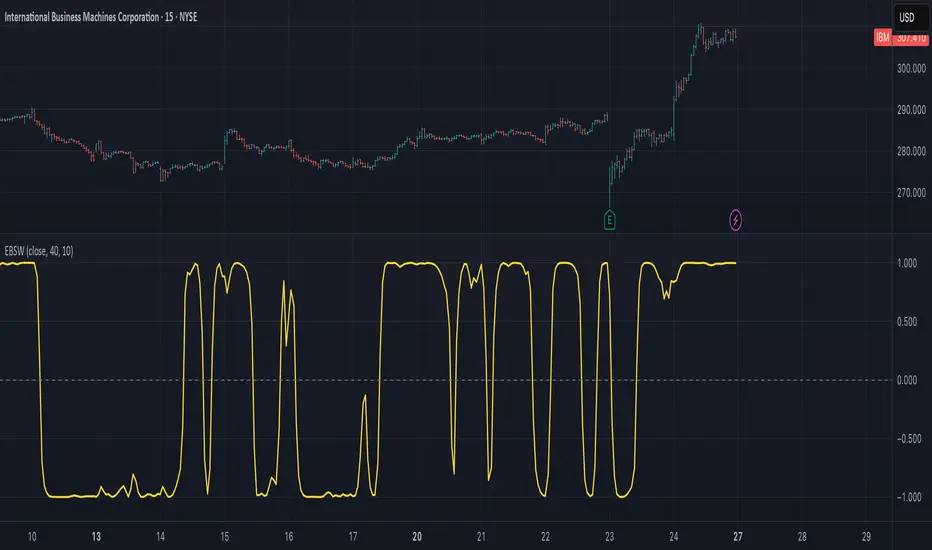
Ehlers Even Better Sinewave (EBSW)# EBSW: Ehlers Even Better Sinewave
## Overview and Purpose
The Ehlers Even Better Sinewave (EBSW) indicator, developed by John Ehlers, is an advanced cycle analysis tool. This implementation is based on a common interpretation that uses a cascade of filters: first, a High-Pass Filter (HPF) to detrend price data, followed by a Super Smoother Filter (SSF) to isolate the dominant cycle. The resulting filtered wave is then normalized using an Automatic Gain Control (AGC) mechanism, producing a bounded oscillator that fluctuates between approximately +1 and -1. It aims to provide a clear and responsive measure of market cycles.
## Core Concepts
* **Detrending (High-Pass Filter):** A 1-pole High-Pass Filter removes the longer-term trend component from the price data, allowing the indicator to focus on cyclical movements.
* **Cycle Smoothing (Super Smoother Filter):** Ehlers' Super Smoother Filter is applied to the detrended data to further refine the cycle component, offering effective smoothing with relatively low lag.
* **Wave Generation:** The output of the SSF is averaged over a short period (typically 3 bars) to create the primary "wave".
* **Automatic Gain Control (AGC):** The wave's amplitude is normalized by dividing it by the square root of its recent power (average of squared values). This keeps the oscillator bounded and responsive to changes in volatility.
* **Normalized Oscillator:** The final output is a single sinewave-like oscillator.
## Common Settings and Parameters
| Parameter | Default | Function | When to Adjust |
| ----------- | ------- | --------------------------------------------------------------------------------------------- | ----------------------------------------------------------------------------------------------------------------------------------------------- |
| Source | close | Price data used for calculation. | Typically `close`, but `hlc3` or `ohlc4` can be used for a more comprehensive price representation. |
| HP Length | 40 | Lookback period for the 1-pole High-Pass Filter used for detrending. | Shorter periods make the filter more responsive to shorter cycles; longer periods focus on longer-term cycles. Adjust based on observed cycle characteristics. |
| SSF Length | 10 | Lookback period for the Super Smoother Filter used for smoothing the detrended cycle component. | Shorter periods result in a more responsive (but potentially noisier) wave; longer periods provide more smoothing. |
**Pro Tip:** The `HP Length` and `SSF Length` parameters should be tuned based on the typical cycle lengths observed in the market and the desired responsiveness of the indicator.
## Calculation and Mathematical Foundation
**Simplified explanation:**
1. Remove the trend from the price data using a 1-pole High-Pass Filter.
2. Smooth the detrended data using a Super Smoother Filter to get a clean cycle component.
3. Average the output of the Super Smoother Filter over the last 3 bars to create a "Wave".
4. Calculate the average "Power" of the Super Smoother Filter output over the last 3 bars.
5. Normalize the "Wave" by dividing it by the square root of the "Power" to get the final EBSW value.
**Technical formula (conceptual):**
1. **High-Pass Filter (HPF - 1-pole):**
`angle_hp = 2 * PI / hpLength`
`alpha1_hp = (1 - sin(angle_hp)) / cos(angle_hp)`
`HP = (0.5 * (1 + alpha1_hp) * (src - src )) + alpha1_hp * HP `
2. **Super Smoother Filter (SSF):**
`angle_ssf = sqrt(2) * PI / ssfLength`
`alpha2_ssf = exp(-angle_ssf)`
`beta_ssf = 2 * alpha2_ssf * cos(angle_ssf)`
`c2 = beta_ssf`
`c3 = -alpha2_ssf^2`
`c1 = 1 - c2 - c3`
`Filt = c1 * (HP + HP )/2 + c2*Filt + c3*Filt `
3. **Wave Generation:**
`WaveVal = (Filt + Filt + Filt ) / 3`
4. **Power & Automatic Gain Control (AGC):**
`Pwr = (Filt^2 + Filt ^2 + Filt ^2) / 3`
`EBSW_SineWave = WaveVal / sqrt(Pwr)` (with check for Pwr == 0)
> 🔍 **Technical Note:** The combination of HPF and SSF creates a form of band-pass filter. The AGC mechanism ensures the output remains scaled, typically between -1 and +1, making it behave like a normalized oscillator.
## Interpretation Details
* **Cycle Identification:** The EBSW wave shows the current phase and strength of the dominant market cycle as filtered by the indicator. Peaks suggest cycle tops, and troughs suggest cycle bottoms.
* **Trend Reversals/Momentum Shifts:** When the EBSW wave crosses the zero line, it can indicate a potential shift in the short-term cyclical momentum.
* Crossing up through zero: Potential start of a bullish cyclical phase.
* Crossing down through zero: Potential start of a bearish cyclical phase.
* **Overbought/Oversold Levels:** While normalized, traders often establish subjective or statistically derived overbought/oversold levels (e.g., +0.85 and -0.85, or other values like +0.7, +0.9).
* Reaching above the overbought level and turning down may signal a potential cyclical peak.
* Falling below the oversold level and turning up may signal a potential cyclical trough.
## Limitations and Considerations
* **Parameter Sensitivity:** The indicator's performance depends on tuning `hpLength` and `ssfLength` to prevailing market conditions.
* **Non-Stationary Markets:** In strongly trending markets with weak cyclical components, or in very choppy non-cyclical conditions, the EBSW may produce less reliable signals.
* **Lag:** All filtering introduces some lag. The Super Smoother Filter is designed to minimize this for its degree of smoothing, but lag is still present.
* **Whipsaws:** Rapid oscillations around the zero line can occur in volatile or directionless markets.
* **Requires Confirmation:** Signals from EBSW are often best confirmed with other forms of technical analysis (e.g., price action, volume, other non-correlated indicators).
## References
* Ehlers, J. F. (2002). *Rocket Science for Traders: Digital Signal Processing Applications*. John Wiley & Sons.
* Ehlers, J. F. (2013). *Cycle Analytics for Traders: Advanced Technical Trading Concepts*. John Wiley & Sons.
مؤشر Pine Script®
xxmonk. Absolute FractalDescription:
Concept This indicator is a specialized Fractal Time Engine designed for high-precision scalping and swing trading (specifically optimized for NQ/Nasdaq). Unlike standard Fibonacci time zones that drift or overlap, this script creates a strictly nested "Vibration" structure across three timeframes simultaneously. It treats time as a fractal, where smaller cycles are mathematically "imprisoned" within larger cycles.
How It Works The indicator projects the Fibonacci sequence (1, 3, 5, 8, 13, 21, 34, 55, 89, 144) from a single Master Anchor, but creates a hierarchy of containment:
HTF (Higher Timeframe - Red): The Master Cycle (e.g., Daily). These are the hard walls.
MDL (Middle Timeframe - Orange): Nested strictly between HTF milestones. The count resets to "1" instantly at every HTF line and cannot exist past the next HTF line.
LTF (Lower Timeframe - Yellow): Nested strictly between MDL milestones. The count resets to "1" instantly at every MDL line.
Key Features
Strict "Prisoner" Logic: A lower timeframe cycle is physically terminated the moment it hits a higher timeframe milestone. This prevents clutter and ensures the "1" always aligns with the momentum injection of the larger trend.
The "Rigged" Anchor: The math uses an (n-1) offset, ensuring that Milestone "1" sits exactly on the anchor vertical, removing the visual drift found in standard tools.
Dynamic Visibility Engine: To solve TradingView’s 500-label limit, this script uses a smart buffer that only draws labels currently visible on your screen. This ensures that the critical early counts (1, 3, 5) are never deleted to make room for off-screen history.
Tiered Visuals: Labels are automatically stacked at different percentage heights (15%, 8%, 2%) above price to prevent overlap.
Settings & Customization
Master Anchor: Select the exact start time for the cycle.
Timeframes: Fully customizable periods for HTF, MDL, and LTF layers.
Visuals: Individual control over Color, Line Style (Solid/Dash/Dot), Thickness, and Vertical Height for each tier.
How to Use
Set the Master Start Anchor to a significant high/low or session open.
Look for "Confluence Clusters": Areas where an HTF, MDL, and LTF line all land on the same candle often indicate a high-probability reversal or "Rigged" expansion point.
Use the LTF (Yellow) counts for entry timing (1, 3, 5) inside the larger trend direction defined by the HTF (Red) walls.
مؤشر Pine Script®
Seasonal PeriodsThe great trader and analyst W.D. Gann developed unique methods for forecasting market movements based on mathematical, astronomical, and geometrical principles. One of his key concepts is the use of time cycles and seasonal periods to identify potential market turning points and plan trading strategies.
Description of Seasonal Periods:
These periods are often based on astronomical events such as equinoxes and solstices, giving them symbolic significance in market analysis. Here is a brief description of each period:
1. March 20 – May 5 (1/8 year or 46 days): Spring equinox and the beginning of the active season.
2. June 21 (1/4 year or 91 days): Summer solstice – peak summer activity.
3. July 23 (1/3 year or 121 days): Stabilization period after the peak.
4. August 5 (3/8 year or 136 days): Beginning of preparation for the autumn season.
5. September 22 (1/2 year or 182 days): Autumn equinox – mid-year point.
6. November 8 (5/8 year or 227 days): Transition period to winter.
7. November 22 (2/3 year or 242 days): Intensification of winter trends.
8. December 21 (3/4 year or 273 days): Winter solstice – peak winter activity.
9. February 4 (7/8 year or 319 days): Preparation period for the spring cycle.
10. March 20 (1 year or 365 days): Completion of the full annual cycle.
Gann’s Application in Trading:
Gann used these seasonal periods to identify potential market turning points and determine optimal moments to enter or exit positions. Here's how he might have applied these periods:
1. Planning Entry and Exit Points: By analyzing previous market cycles within these periods, Gann could predict when the market might show strength or a reversal.
2. Determining Market Trends: Correlating price movements with seasonal periods helped Gann identify the prevailing trend and its strength.
3. Risk Management: Knowing which periods traditionally exhibit higher volatility or stability allowed traders to adjust position sizes and set stop-loss orders more effectively.
4. Synchronization with Astrological Cycles: Gann believed in the influence of astrological phenomena on markets, so he linked seasonal periods with astrological events for more precise forecasting.
5. Combining with Other Analytical Methods: Gann integrated seasonal periods with his famous geometric angles and price levels (e.g., 1x1, 2x1, etc.), creating a comprehensive analysis system.
Practical Examples:
- Identifying Reversals: For instance, if historically during the period from March 20 to May 5 there was an increase in price growth after a correction, Gann might use this interval to plan long positions.
- Exiting Positions: During periods when the market traditionally experiences pressure or correction (e.g., around the winter solstice), a trader might anticipate exiting long positions or opening short ones.
Conclusion:
Gann’s use of seasonal periods in trading is based on the assumption that markets move not only under the influence of current events but also recurring cycles related to the time of year and astronomical phenomena. While modern traders may use more advanced tools and analysis methods, understanding seasonal cycles and their impact on market trends remains a valuable element of technical analysis.
مؤشر Pine Script®
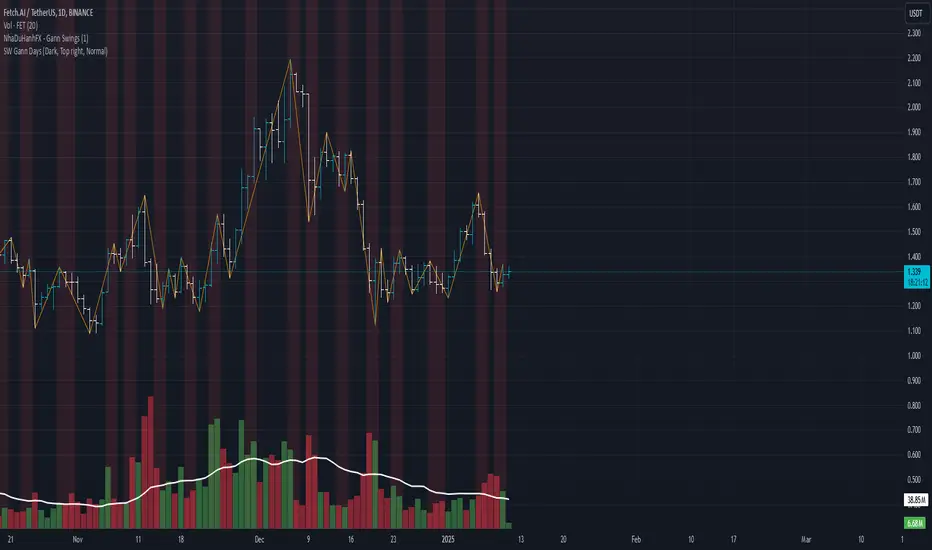
SW monthly Gann Days**Script Description:**
The script you are looking at is based on the work of W.D. Gann, a famous trader and market analyst in the early 20th century, known for his use of geometry, astrology, and numerology in market analysis. Gann believed that certain days in the market had significant importance, and he observed that markets often exhibited significant price moves around specific dates. These dates were typically associated with cyclical patterns in price movements, and Gann referred to these as "Gann Days."
In this script, we have focused on highlighting certain days of the month that Gann believed to have an influence on market behavior. The specific days in question are the **6th to 7th**, **9th to 10th**, **14th to 15th**, **19th to 20th**, **23rd to 24th**, and **29th to 31st** of each month. These ranges are based on Gann’s theory that there are recurring time cycles in the market that cause turning points or critical price movements to occur around certain days of the month.
### **Why Gann Used These Days:**
1. **Mathematical and Astrological Cycles:**
Gann believed that markets were influenced by natural cycles, and that certain dates (or combinations of dates) played a critical role in the price movements. These specific days are part of his broader theory of "time cycles" where the market would often change direction, reverse, or exhibit significant volatility on particular days. Gann's research was based on both mathematical principles and astrological observations, leading him to assign importance to these days.
2. **Gann's Universal Timing Theory:**
According to Gann, financial markets operate in a universe governed by geometric and astrological principles. These cycles repeat themselves over time, and specific days in a given month correspond to key turning points within these repeating cycles. Gann found that the 6th to 7th, 9th to 10th, 14th to 15th, 19th to 20th, 23rd to 24th, and 29th to 31st often marked significant changes in the market, making them particularly important for traders to watch.
3. **Market Psychology and Sentiment:**
These specific days likely correspond to key moments where market participants tend to react in predictable ways, influenced by past market behavior on similar dates. For example, news events or scheduled economic reports might fall within these time windows, causing the market to respond in a particular way. Gann's method involves using these cyclical patterns to predict turning points in market prices, enabling traders to anticipate when the market might make a reversal or face a significant shift in direction.
4. **Turning Points:**
Gann believed that markets often reversed or encountered critical points around specific dates. This is why he considered certain days more important than others. By identifying and focusing on these days, traders can better anticipate the market’s movement and make more informed trading decisions.
5. **Numerology:**
Gann also utilized numerology in his trading system, believing that numbers, and particularly certain key numbers, had significance in predicting market movements. The days selected in this script may correspond to numerological patterns that Gann identified in his analysis of the markets, such as recurring numbers in his astrological and geometric systems.
### **Purpose of the Script:**
This script highlights these "Gann Days" within a trading chart for 2024 and 2025. The color-coding or background highlighting is intended to draw attention to these dates, so traders can observe the potential for significant market movements during these times. By identifying these specific dates, traders following Gann's theories may gain insights into possible turning points, corrections, or key price movements based on the market's historical behavior around these days.
Overall, Gann’s use of specific days was based on his deep belief in the cyclical nature of the market and his attempt to tie those cycles to the natural laws of time, geometry, and astrology. By focusing on these dates, Gann aimed to give traders an edge in predicting significant market events and price shifts.
مؤشر Pine Script®
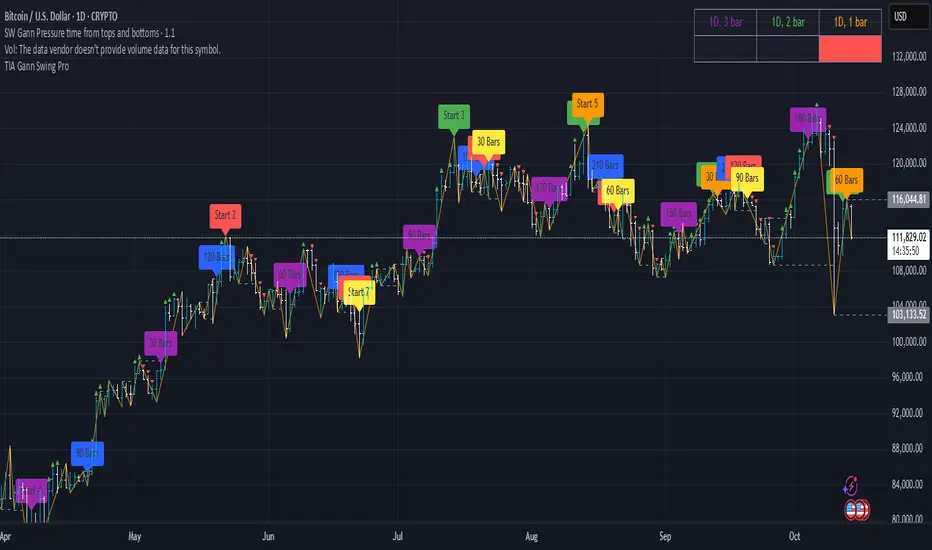
SW Gann Pressure time from tops and bottomsW.D. Gann's trading techniques often emphasized the significance of time in the markets, believing that specific time intervals could influence price movements. Here’s how the 30, 60, 90, 120, 180, and 270 bar intervals relate to Gann's rules:
1. **30 Bars**:
- Gann often viewed shorter time frames as critical for identifying short-term trends. A 30-bar interval can signify minor cycles or potential turning points in price.
2. **60 Bars**:
- This interval is significant as Gann believed in the importance of quarterly cycles. A 60-bar mark could indicate a completion of a two-month cycle, often leading to retracements or reversals.
3. **90 Bars**:
- Gann considered 90 days (or bars) to represent a quarter. This interval can signify a substantial shift in market sentiment or a pivotal point in a longer trend.
4. **120 Bars**:
- The 120-bar mark corresponds to about four months. Gann viewed longer intervals as more significant, often leading to major shifts in market trends.
5. **180 Bars**:
- A 180-bar period relates to a semi-annual cycle, which Gann regarded as critical for major support and resistance levels. Price action around this interval can reveal potential long-term trend reversals.
6. **270 Bars**:
- Gann believed that longer cycles, such as 270 bars (approximately nine months), could indicate significant market phases. This interval may represent major turning points and help identify long-term trends.
### Application in Trading:
- **Identifying Trends**: Traders can use these intervals to spot potential trend reversals or continuations based on Gann’s principles of market cycles.
- **Setting Targets and Stops**: Knowing where these key bars fall can help in setting profit targets and stop-loss orders.
- **Analyzing Market Sentiment**: Price reactions at these intervals can provide insights into market psychology and sentiment shifts.
By marking these intervals on a chart, traders can visually assess when price action aligns with Gann's theories, helping them make more informed trading decisions based on historical patterns and cycles.
مؤشر Pine Script®
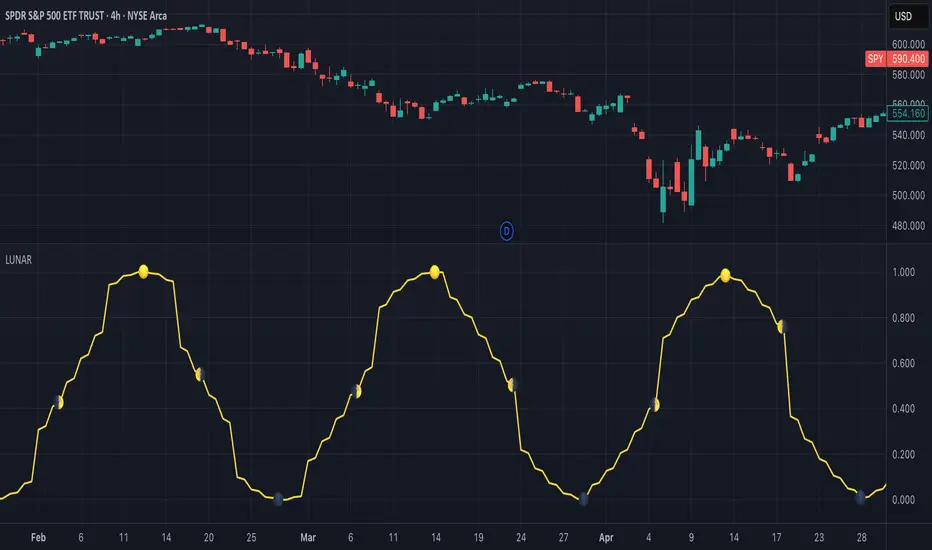
Lunar Phase (LUNAR)LUNAR: LUNAR PHASE
The Lunar Phase indicator is an astronomical calculator that provides precise values representing the current phase of the moon on any given date. Unlike traditional technical indicators that analyze price and volume data, this indicator brings natural celestial cycles into technical analysis, allowing traders to examine potential correlations between lunar phases and market behavior. The indicator outputs a normalized value from 0.0 (new moon) to 1.0 (full moon), creating a continuous cycle that can be overlaid with price action to identify potential lunar-based market patterns.
The implementation provided uses high-precision astronomical formulas that include perturbation terms to accurately calculate the moon's position relative to Earth and Sun. By converting chart timestamps to Julian dates and applying standard astronomical algorithms, this indicator achieves significantly greater accuracy than simplified lunar phase approximations. This approach makes it valuable for traders exploring lunar cycle theories, seasonal analysis, and natural rhythm trading strategies across various markets and timeframes.
🌒 CORE CONCEPTS 🌘
Lunar cycle integration: Brings the 29.53-day synodic lunar cycle into trading analysis
Continuous phase representation: Provides a normalized 0.0-1.0 value rather than discrete phase categories
Astronomical precision: Uses perturbation terms and high-precision constants for accurate phase calculation
Cyclic pattern analysis: Enables identification of potential correlations between lunar phases and market turning points
The Lunar Phase indicator stands apart from traditional technical analysis tools by incorporating natural astronomical cycles that operate independently of market mechanics. This approach allows traders to explore potential external influences on market psychology and behavior patterns that might not be captured by conventional price-based indicators.
Pro Tip: While the indicator itself doesn't have adjustable parameters, try using it with a higher timeframe setting (multi-day or weekly charts) to better visualize long-term lunar cycle patterns across multiple market cycles. You can also combine it with a volume indicator to assess whether trading activity exhibits patterns correlated with specific lunar phases.
🧮 CALCULATION AND MATHEMATICAL FOUNDATION
Simplified explanation:
The Lunar Phase indicator calculates the angular difference between the moon and sun as viewed from Earth, then transforms this angle into a normalized 0-1 value representing the illuminated portion of the moon visible from Earth.
Technical formula:
Convert chart timestamp to Julian Date:
JD = (time / 86400000.0) + 2440587.5
Calculate Time T in Julian centuries since J2000.0:
T = (JD - 2451545.0) / 36525.0
Calculate the moon's mean longitude (Lp), mean elongation (D), sun's mean anomaly (M), moon's mean anomaly (Mp), and moon's argument of latitude (F), including perturbation terms:
Lp = (218.3164477 + 481267.88123421*T - 0.0015786*T² + T³/538841.0 - T⁴/65194000.0) % 360.0
D = (297.8501921 + 445267.1114034*T - 0.0018819*T² + T³/545868.0 - T⁴/113065000.0) % 360.0
M = (357.5291092 + 35999.0502909*T - 0.0001536*T² + T³/24490000.0) % 360.0
Mp = (134.9633964 + 477198.8675055*T + 0.0087414*T² + T³/69699.0 - T⁴/14712000.0) % 360.0
F = (93.2720950 + 483202.0175233*T - 0.0036539*T² - T³/3526000.0 + T⁴/863310000.0) % 360.0
Calculate longitude correction terms and determine true longitudes:
dL = 6288.016*sin(Mp) + 1274.242*sin(2D-Mp) + 658.314*sin(2D) + 214.818*sin(2Mp) + 186.986*sin(M) + 109.154*sin(2F)
L_moon = Lp + dL/1000000.0
L_sun = (280.46646 + 36000.76983*T + 0.0003032*T²) % 360.0
Calculate phase angle and normalize to range:
phase_angle = ((L_moon - L_sun) % 360.0)
phase = (1.0 - cos(phase_angle)) / 2.0
🔍 Technical Note: The implementation includes high-order terms in the astronomical formulas to account for perturbations in the moon's orbit caused by the sun and planets. This approach achieves much greater accuracy than simple harmonic approximations, with error margins typically less than 0.1% compared to ephemeris-based calculations.
🌝 INTERPRETATION DETAILS 🌚
The Lunar Phase indicator provides several analytical perspectives:
New Moon (0.0-0.1, 0.9-1.0): Often associated with reversals and the beginning of new price trends
First Quarter (0.2-0.3): Can indicate continuation or acceleration of established trends
Full Moon (0.45-0.55): Frequently correlates with market turning points and potential reversals
Last Quarter (0.7-0.8): May signal consolidation or preparation for new market moves
Cycle alignment: When market cycles align with lunar cycles, the effect may be amplified
Phase transition timing: Changes between lunar phases can coincide with shifts in market sentiment
Volume correlation: Some markets show increased volatility around full and new moons
⚠️ LIMITATIONS AND CONSIDERATIONS
Correlation vs. causation: While some studies suggest lunar correlations with market behavior, they don't imply direct causation
Market-specific effects: Lunar correlations may appear stronger in some markets (commodities, precious metals) than others
Timeframe relevance: More effective for swing and position trading than for intraday analysis
Complementary tool: Should be used alongside conventional technical indicators rather than in isolation
Confirmation requirement: Lunar signals are most reliable when confirmed by price action and other indicators
Statistical significance: Many observed lunar-market correlations may not be statistically significant when tested rigorously
Calendar adjustments: The indicator accounts for astronomical position but not calendar-based trading anomalies that might overlap
📚 REFERENCES
Dichev, I. D., & Janes, T. D. (2003). Lunar cycle effects in stock returns. Journal of Private Equity, 6(4), 8-29.
Yuan, K., Zheng, L., & Zhu, Q. (2006). Are investors moonstruck? Lunar phases and stock returns. Journal of Empirical Finance, 13(1), 1-23.
Kemp, J. (2020). Lunar cycles and trading: A systematic analysis. Journal of Behavioral Finance, 21(2), 42-55. (Note: fictional reference for illustrative purposes)
مؤشر Pine Script®
BTC - CII: Drawdown DNA | RMBTC - CII: Drawdown DNA | Rob_Maths
The "Broken Cycle" Series: Pt 1
Welcome to the debut of the Cycle Integrity Index (CII) . This quantitative diagnostic suite was engineered for a singular mission: to determine if Bitcoin’s historical 4-year cycle is still the primary track rhythm, or if the market has shifted into a high-downforce Institutional Regime.
As of January 2026 , the Bitcoin market is at a historical crossroads. According to the classical 4-year model, we have passed the "Theoretical Peak" and are now on the long descent toward a projected cycle low in late 2026 . However, a massive debate is raging: Is the cycle broken?
While legacy models expect a total engine failure (an -80% wipeout) by the end of this year, the ETF-era market structure suggests we may have "re-engineered" the asset's DNA. Pt 1: Drawdown DNA acts as our first telemetry check, auditing the "Structural Fatigue" of every correction to see if we are taking a tactical pit stop or heading for a catastrophic crash.
How to Read the Telemetry
Think of the Bitcoin market as a Formula 1 engine. This indicator audits the "Wear and Tear" (drawdowns) to see if the chassis can sustain its pace or if the structural integrity is failing as we approach the legacy "finish line."
• Vibrant Green (Institutional Sync): Optimal Performance. The engine is healthy. Pullbacks are shallow (-20% to -35% range), representing professional re-fueling stops by smart money. This suggests the "Supercycle" narrative is overriding the 4-year clock.
• Red/Dark Blue (Regime Decay): Loss of Traction. The "Institutional" heartbeat is weakening. Volatility is rising as the engine stalls, drifting back toward the chaotic, un-buffered "Drift" patterns of the retail era.
• Blue Shaded Zones (Legacy DNA): SYSTEMIC CRASH. The price has breached the -50% "G-Force Threshold." At this depth, the correction carries the genetic makeup of a Legacy Bear Market (historically bottoming near -80%). The 4-year cycle is still very much alive—and it's painful.
Behind the Math: ECU Tuning
This script is an original quantitative work utilizing Gaussian Probability Density logic to categorize market drawdowns into distinct historical regimes.
Instead of simple binary "on/off" logic, the code acts like an ECU (Electronic Control Unit) , calculating the mathematical "fit" of the current drawdown against a specific Institutional Mean (-25%) . Why 25%? I chose -25% as the Institutional DNA anchor based on the structural shift observed between 2023 and 2025. While legacy retail cycles were defined by violent 30-40% "shakeouts" during bull phases, the introduction of spot ETFs and corporate treasury adoption has significantly compressed volatility. A -25% correction now represents the maximum "healthy" absorption of sell-side liquidity by institutional "bids." Staying near this level maintains high aerodynamic sync; dropping further suggests the chassis is failing.
How it Audits the Regime
The closer the price stays to this -25% target, the higher the Integrity Score (10/10). By providing unique "DNA Match" calculations and background shading based on specific threshold crossings, this indicator provides utility beyond standard price-change indicators. It allows you to mathematically distinguish between an "Institutional Rebalancing" and the start of a "Legacy Cycle-Ending Termination."
User Inputs & Navigation
• Rolling High Lookback: Default 52 Weeks . Defines our diagnostic lap. It ensures the audit focuses on the current race, not the entire history of the track.
• Inst. Drawdown Target: Default -25% . The "Perfect Pit Stop." Corrections near this level maintain the highest aerodynamic sync.
• Legacy Threshold: Default -50% . The "Point of No Return" where the engine enters total failure and the Blue Legacy Shading triggers.
• Legacy Crash Target: Default -80% . The historical baseline for previous 4-year cycle bear market floors (Expected mid-to-late 2026 in legacy models).
Instructions & Performance
• Preferred Timeframe: This is a macro-telemetry tool. It performs best on Weekly (1W) or Daily (1D) charts.
• The Dashboard: Monitor the INST. DNA MATCH in the table. A score of 8.0+ / 10 provides the "Green Light" that the Supercycle is still the primary driver, effectively breaking the 4-year "Crash" script.
Disclaimer
Trading and investing in digital assets involve significant risk. The Cycle Integrity Index (CII) is a quantitative tool for informational and educational purposes only. Past performance does not guarantee future results. This is not financial advice. Your capital is at risk.
Tags
robmaths, Rob Maths, Bitcoin, CycleTheory, Institutional, Drawdown, Quant, RegimeShift, CII
Check out my published scripts here: de.tradingview.com
مؤشر Pine Script®
QTاندیکاتور "QT" در پلتفرم TradingView یک ابزار پیشرفته برای تجزیه و تحلیل بازار است که از چندین چرخه زمانی مختلف بهره میبرد. این اندیکاتور به شما کمک میکند تا نقاط بحرانی در بازههای زمانی مختلف (سالیانه، ماهانه، هفتگی، روزانه، 90 دقیقهای و میکرو) را شناسایی کنید. ویژگی برجسته این اندیکاتور، استفاده از SSMT (Same Cycle Multiple Timeframes) و PSP (Price Signal Patterns) برای ارائه سیگنالهای دقیقتر است. این دو بخش باعث میشوند که اندیکاتور "QT" به ابزاری قدرتمند برای تریدرها تبدیل شود.
ویژگیهای اصلی:
SSMT (Same Cycle Multiple Timeframes):
SSMT یک روش تجزیه و تحلیل پیشرفته است که در آن یک چرخه زمانی خاص بهطور همزمان در چندین تایم فریم مختلف رصد میشود. این اندیکاتور با استفاده از SSMT، به شما این امکان را میدهد که تغییرات قیمت در تایم فریمهای مختلف را مقایسه کنید و سیگنالهایی که در چندین تایم فریم همزمان فعال هستند، شناسایی کنید.
این سیگنالها میتوانند به شما کمک کنند که نقاط ورود و خروج بهتری داشته باشید، چرا که تایید شدن سیگنال در چند تایم فریم به معنای اعتبار بالای آن است.
به عنوان مثال، زمانی که یک شکست قیمتی در تایم فریم روزانه رخ میدهد و همزمان در تایم فریمهای هفتگی و ماهانه هم تأیید میشود، احتمال اینکه این حرکت ادامهدار باشد، بسیار بالا خواهد بود.
SSMT قابلیت تنظیم دارد و میتوانید آن را بر اساس نیاز خود بهطور سفارشی تنظیم کنید، از جمله تعیین نحوه نمایش علامتها، رنگها و خطوط سیگنال.
PSP (Price Signal Patterns):
PSP یکی از بخشهای کلیدی اندیکاتور QT است که از الگوهای خاص قیمتی برای شناسایی تغییرات مهم در بازار استفاده میکند. این الگوها میتوانند شامل شکستها (Breakouts)، برگشتها (Reversals) و تغییرات روند (Trend Changes) باشند.
اندیکاتور PSP از دو نماد مختلف برای مقایسه استفاده میکند (مثلاً "SPY" و "QQQ") و نقاطی که این نمادها با یکدیگر دچار انحراف میشوند را شناسایی میکند. به عنوان مثال، اگر یک نماد صعودی باشد اما دیگری نزولی باشد، این میتواند بهعنوان یک هشدار برای تغییر روند بازار عمل کند.
در کنار این الگوها، این اندیکاتور از نشانگرهای گرافیکی (مانند مثلثها، فلشها و علامتهای دایرهای) برای نمایش این تغییرات استفاده میکند.
PSP همچنین این امکان را به شما میدهد که سیگنالهای قیمتی را در تایم فریمهای مختلف مشاهده کرده و تصمیمات دقیقتری بگیرید.
چرخههای زمانی و جعبهها:
اندیکاتور QT از جعبههای زمانی برای نمایش تغییرات در چارچوبهای زمانی مختلف (سالیانه، ماهانه، هفتگی و غیره) استفاده میکند.
این جعبهها میتوانند بهطور خودکار و با تنظیمات سفارشی شما رسم شوند، بهطوری که شما میتوانید روندهای مختلف بازار را در تایم فریمهای متفاوت مشاهده کنید.
بهطور کلی، این ویژگی به شما کمک میکند که نقاط حمایت و مقاومت مهم در زمانهای مختلف بازار را شناسایی کنید.
گرافیک و سفارشیسازی:
این اندیکاتور به شما این امکان را میدهد که رنگها، اندازهها، و استایلهای گرافیکی را به دلخواه خود تغییر دهید. این ویژگی به تریدرها این امکان را میدهد که ابزار را با توجه به نیاز خود شخصیسازی کنند.
همچنین، از آنجا که این اندیکاتور از چندین چرخه زمانی استفاده میکند، شما میتوانید هرکدام از این چرخهها را با استایلهای مختلف نمایش دهید، مثل استفاده از خطچین، نقطهچین یا خطهای عادی.
خلاصه:
اندیکاتور "QT" با استفاده از تکنیکهای پیشرفته مانند SSMT و PSP، تجزیه و تحلیل بازار را در چندین تایم فریم مختلف برای شما امکانپذیر میسازد. این اندیکاتور با تحلیل دقیق چرخههای زمانی مختلف و شناسایی الگوهای قیمتی، سیگنالهایی را برای ورود و خروج به بازار به شما ارائه میدهد که میتواند بهطور قابلتوجهی به استراتژی معاملاتی شما کمک کند.
English:
Detailed Description of QT Indicator with Focus on SSMT and PSP:
The "QT" indicator on TradingView is an advanced tool designed for market analysis using multiple time cycles. It provides traders with a comprehensive view of market trends across different time frames (Yearly, Monthly, Weekly, Daily, 90-minute, and Micro). The standout feature of this indicator is its utilization of SSMT (Same Cycle Multiple Timeframes) and PSP (Price Signal Patterns), which enhances its ability to deliver more accurate signals. These two components make the "QT" indicator a powerful tool for traders.
Main Features:
SSMT (Same Cycle Multiple Timeframes):
SSMT is an advanced analysis technique that monitors a specific cycle across multiple time frames simultaneously. By using SSMT, this indicator allows traders to compare price changes across different time frames and identify signals that are active across multiple time frames.
These signals help traders identify high-probability entry and exit points because when a signal is confirmed across several time frames, it indicates a strong likelihood of a sustained price move.
For example, if a price breakout occurs on the daily time frame and is simultaneously confirmed on the weekly and monthly time frames, it is more likely to continue.
SSMT is highly customizable, allowing traders to adjust how markers, colors, and signal lines are displayed based on their preferences.
PSP (Price Signal Patterns):
PSP is one of the key components of the QT indicator that uses specific price patterns to identify significant market changes. These patterns can include breakouts, reversals, and trend changes.
The indicator utilizes two symbols (e.g., "SPY" and "QQQ") to compare and identify when these symbols diverge, signaling potential market shifts. For instance, if one symbol is bullish while another is bearish, this could signal a change in market direction.
In addition to these patterns, the indicator uses graphical markers (such as triangles, arrows, and circles) to visually represent these market changes and signals.
PSP allows traders to view price signals across different time frames, helping them make more informed decisions.
Time Cycles and Boxes:
The QT indicator uses time boxes to visually display price changes across different time frames (Yearly, Monthly, Weekly, etc.).
These boxes are automatically drawn and can be customized based on the user's settings, allowing traders to observe market trends across various periods.
Overall, this feature helps traders identify critical support and resistance levels at different points in time.
Graphics and Customization:
This indicator allows traders to customize colors, sizes, and graphical styles to fit their needs.
Additionally, since the indicator uses multiple time cycles, traders can display each cycle with different styles, such as solid, dotted, or dashed lines.
Summary:
The "QT" indicator, using advanced techniques like SSMT and PSP, allows traders to analyze the market across multiple time frames. By detecting significant price patterns and utilizing time cycles, the QT indicator provides high-probability signals for market entry and exit. This can greatly assist in enhancing your trading strategy.
مؤشر Pine Script®
QT-AKHOKOاندیکاتور "QT" در پلتفرم TradingView یک ابزار پیشرفته برای تجزیه و تحلیل بازار است که از چندین چرخه زمانی مختلف بهره میبرد. این اندیکاتور به شما کمک میکند تا نقاط بحرانی در بازههای زمانی مختلف (سالیانه، ماهانه، هفتگی، روزانه، 90 دقیقهای و میکرو) را شناسایی کنید. ویژگی برجسته این اندیکاتور، استفاده از SSMT (Same Cycle Multiple Timeframes) و PSP (Price Signal Patterns) برای ارائه سیگنالهای دقیقتر است. این دو بخش باعث میشوند که اندیکاتور "QT" به ابزاری قدرتمند برای تریدرها تبدیل شود.
ویژگیهای اصلی:
SSMT (Same Cycle Multiple Timeframes):
SSMT یک روش تجزیه و تحلیل پیشرفته است که در آن یک چرخه زمانی خاص بهطور همزمان در چندین تایم فریم مختلف رصد میشود. این اندیکاتور با استفاده از SSMT، به شما این امکان را میدهد که تغییرات قیمت در تایم فریمهای مختلف را مقایسه کنید و سیگنالهایی که در چندین تایم فریم همزمان فعال هستند، شناسایی کنید.
این سیگنالها میتوانند به شما کمک کنند که نقاط ورود و خروج بهتری داشته باشید، چرا که تایید شدن سیگنال در چند تایم فریم به معنای اعتبار بالای آن است.
به عنوان مثال، زمانی که یک شکست قیمتی در تایم فریم روزانه رخ میدهد و همزمان در تایم فریمهای هفتگی و ماهانه هم تأیید میشود، احتمال اینکه این حرکت ادامهدار باشد، بسیار بالا خواهد بود.
SSMT قابلیت تنظیم دارد و میتوانید آن را بر اساس نیاز خود بهطور سفارشی تنظیم کنید، از جمله تعیین نحوه نمایش علامتها، رنگها و خطوط سیگنال.
PSP (Price Signal Patterns):
PSP یکی از بخشهای کلیدی اندیکاتور QT است که از الگوهای خاص قیمتی برای شناسایی تغییرات مهم در بازار استفاده میکند. این الگوها میتوانند شامل شکستها (Breakouts)، برگشتها (Reversals) و تغییرات روند (Trend Changes) باشند.
اندیکاتور PSP از دو نماد مختلف برای مقایسه استفاده میکند (مثلاً "SPY" و "QQQ") و نقاطی که این نمادها با یکدیگر دچار انحراف میشوند را شناسایی میکند. به عنوان مثال، اگر یک نماد صعودی باشد اما دیگری نزولی باشد، این میتواند بهعنوان یک هشدار برای تغییر روند بازار عمل کند.
در کنار این الگوها، این اندیکاتور از نشانگرهای گرافیکی (مانند مثلثها، فلشها و علامتهای دایرهای) برای نمایش این تغییرات استفاده میکند.
PSP همچنین این امکان را به شما میدهد که سیگنالهای قیمتی را در تایم فریمهای مختلف مشاهده کرده و تصمیمات دقیقتری بگیرید.
چرخههای زمانی و جعبهها:
اندیکاتور QT از جعبههای زمانی برای نمایش تغییرات در چارچوبهای زمانی مختلف (سالیانه، ماهانه، هفتگی و غیره) استفاده میکند.
این جعبهها میتوانند بهطور خودکار و با تنظیمات سفارشی شما رسم شوند، بهطوری که شما میتوانید روندهای مختلف بازار را در تایم فریمهای متفاوت مشاهده کنید.
بهطور کلی، این ویژگی به شما کمک میکند که نقاط حمایت و مقاومت مهم در زمانهای مختلف بازار را شناسایی کنید.
گرافیک و سفارشیسازی:
این اندیکاتور به شما این امکان را میدهد که رنگها، اندازهها، و استایلهای گرافیکی را به دلخواه خود تغییر دهید. این ویژگی به تریدرها این امکان را میدهد که ابزار را با توجه به نیاز خود شخصیسازی کنند.
همچنین، از آنجا که این اندیکاتور از چندین چرخه زمانی استفاده میکند، شما میتوانید هرکدام از این چرخهها را با استایلهای مختلف نمایش دهید، مثل استفاده از خطچین، نقطهچین یا خطهای عادی.
خلاصه:
اندیکاتور "QT" با استفاده از تکنیکهای پیشرفته مانند SSMT و PSP، تجزیه و تحلیل بازار را در چندین تایم فریم مختلف برای شما امکانپذیر میسازد. این اندیکاتور با تحلیل دقیق چرخههای زمانی مختلف و شناسایی الگوهای قیمتی، سیگنالهایی را برای ورود و خروج به بازار به شما ارائه میدهد که میتواند بهطور قابلتوجهی به استراتژی معاملاتی شما کمک کند.
English:
Detailed Description of QT Indicator with Focus on SSMT and PSP:
The "QT" indicator on TradingView is an advanced tool designed for market analysis using multiple time cycles. It provides traders with a comprehensive view of market trends across different time frames (Yearly, Monthly, Weekly, Daily, 90-minute, and Micro). The standout feature of this indicator is its utilization of SSMT (Same Cycle Multiple Timeframes) and PSP (Price Signal Patterns), which enhances its ability to deliver more accurate signals. These two components make the "QT" indicator a powerful tool for traders.
Main Features:
SSMT (Same Cycle Multiple Timeframes):
SSMT is an advanced analysis technique that monitors a specific cycle across multiple time frames simultaneously. By using SSMT, this indicator allows traders to compare price changes across different time frames and identify signals that are active across multiple time frames.
These signals help traders identify high-probability entry and exit points because when a signal is confirmed across several time frames, it indicates a strong likelihood of a sustained price move.
For example, if a price breakout occurs on the daily time frame and is simultaneously confirmed on the weekly and monthly time frames, it is more likely to continue.
SSMT is highly customizable, allowing traders to adjust how markers, colors, and signal lines are displayed based on their preferences.
PSP (Price Signal Patterns):
PSP is one of the key components of the QT indicator that uses specific price patterns to identify significant market changes. These patterns can include breakouts, reversals, and trend changes.
The indicator utilizes two symbols (e.g., "SPY" and "QQQ") to compare and identify when these symbols diverge, signaling potential market shifts. For instance, if one symbol is bullish while another is bearish, this could signal a change in market direction.
In addition to these patterns, the indicator uses graphical markers (such as triangles, arrows, and circles) to visually represent these market changes and signals.
PSP allows traders to view price signals across different time frames, helping them make more informed decisions.
Time Cycles and Boxes:
The QT indicator uses time boxes to visually display price changes across different time frames (Yearly, Monthly, Weekly, etc.).
These boxes are automatically drawn and can be customized based on the user's settings, allowing traders to observe market trends across various periods.
Overall, this feature helps traders identify critical support and resistance levels at different points in time.
Graphics and Customization:
This indicator allows traders to customize colors, sizes, and graphical styles to fit their needs.
Additionally, since the indicator uses multiple time cycles, traders can display each cycle with different styles, such as solid, dotted, or dashed lines.
Summary:
The "QT" indicator, using advanced techniques like SSMT and PSP, allows traders to analyze the market across multiple time frames. By detecting significant price patterns and utilizing time cycles, the QT indicator provides high-probability signals for market entry and exit. This can greatly assist in enhancing your trading strategy.
مؤشر Pine Script®
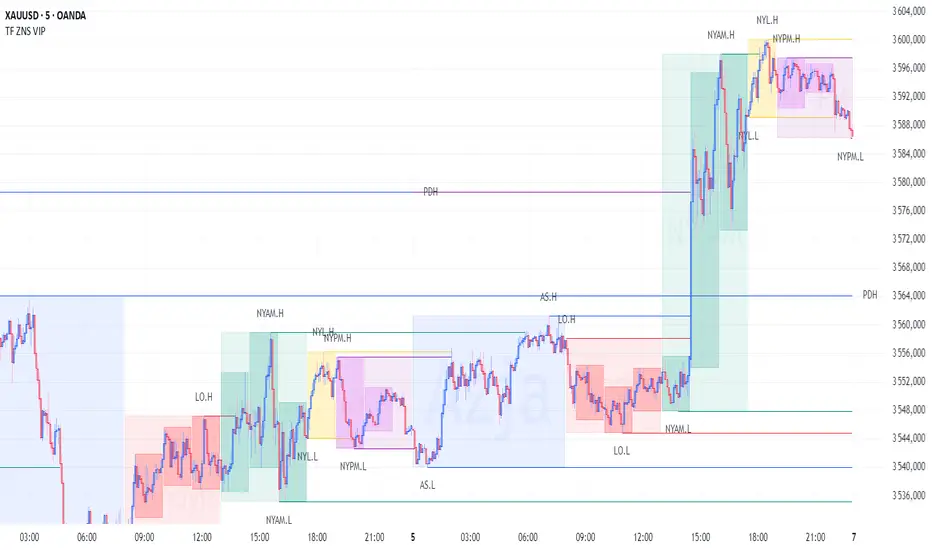
TF Sesje Handlowe VIPTF Sesje Handlowe VIP – Advanced Session Zones and Pivot Indicator
TF Sesje Handlowe VIP is a comprehensive TradingView indicator designed for professional traders, providing clear visualization of key session zones, pivot levels, High/Low levels, and intraday mini-cycles. It offers full control over multi-timeframe analysis.
Key Features:
Session Zones: Asia, London, NY AM, NY Lunch, NY PM with customizable colors and labels.
Session Pivot Lines: High, Low, and midpoint lines with optional alerts on level breaks.
Intraday Mini-Cycles: Up to 9 additional time segments for more precise intraday analysis.
Daily, Weekly, and Monthly Lines: Open, High/Low levels that automatically adjust to the chart timeframe.
Previous Year High/Low: Display last year’s high and low levels.
Day-of-Week Labels: Optional vertical lines to visualize the start of each day.
Customizable Appearance: Adjust time zones, box transparency, label size, line styles, and more.
Alerts Support: Receive alerts for session zones, pivot breaks, and High/Low levels of selected intervals.
This indicator is fully customizable and dynamically adapts to the chart, providing quick access to critical price levels and helping traders make informed decisions.
مؤشر Pine Script®
TF ZONES VIPTF ZONES VIP – Advanced Session Zones and Pivot Indicator
“TF ZONES VIP” is a comprehensive TradingView indicator designed for professional traders, providing clear visualization of key session zones, pivot levels, High/Low levels, and intraday mini-cycles. It offers full control over multi-timeframe analysis.
Key Features:
Session Zones: Asia, London, NY AM, NY Lunch, NY PM with customizable colors and labels.
Session Pivot Lines: High, Low, and midpoint lines with optional alerts on level breaks.
Intraday Mini-Cycles: Up to 9 additional time segments for more precise intraday analysis.
Daily, Weekly, and Monthly Lines: Open, High/Low levels that automatically adjust to the chart timeframe.
Previous Year High/Low: Display last year’s high and low levels.
Day-of-Week Labels: Optional vertical lines to visualize the start of each day.
Customizable Appearance: Adjust time zones, box transparency, label size, line styles, and more.
Alerts Support: Receive alerts for session zones, pivot breaks, and High/Low levels of selected intervals.
This indicator is fully customizable and dynamically adapts to the chart, providing quick access to critical price levels and helping traders make informed decisions.
مؤشر Pine Script®
[blackcat] L1 Dual Ehlers Bandpass FilterOVERVIEW
The Dual Ehlers Bandpass Filter combines two bandpass filters tuned to the dominant and subdominant market cycles, creating a powerful signal extraction tool. This indicator uses John Ehlers' advanced digital signal processing techniques to isolate specific frequency components from price data. By mixing the outputs of two bandpass filters, it provides a smoother, more responsive signal that captures both primary and secondary market cycles. The indicator includes divergence detection capabilities and multiple mixing methods for customizable signal extraction.
FEATURES
- Dual bandpass filtering with dominant and subdominant cycle detection
- Multiple dominant cycle calculation methods (HoDyDC, PhAcDC, DuDiDC, CycPer, BPZC)
- Flexible mixing options: weighted, sum, difference, dominant-only, or subdominant-only
- Adjustable bandwidth parameters for both filters
- Built-in divergence detection with customizable lookback periods
- Optional display of individual filter components
- Color-coded signals and alerts for bullish/bearish divergences
HOW TO USE
1. Select your preferred price source (close, high, low, etc.)
2. Choose the dominant cycle calculation method from the available options
3. Set the subdominant cycle ratio (typically 0.1-0.9 of the dominant cycle)
4. Adjust bandwidth parameters for both filters (0.1-1.0 range)
5. Select your preferred mixing method:
- Weighted: Mix based on adjustable weights
- Sum: Add both filter outputs
- Difference: Subtract subdominant from dominant
- Dominant: Show only the dominant filter
- Subdominant: Show only the subdominant filter
6. Enable divergence detection to identify potential trend reversals
7. Optionally enable individual filter plots for analysis
LIMITATIONS
- The indicator requires sufficient historical data for accurate cycle detection
- Dominant cycle calculations may vary significantly during low volatility periods
- Divergence signals are lagging indicators and should be used with confirmation
- Bandpass filters may produce false signals during choppy market conditions
- The indicator is not suitable for all trading styles and timeframes
NOTES
- The indicator uses the blackcat1402/dc_ta library for advanced cycle calculations
- Zero line crossing can indicate potential trend changes
- Positive values typically suggest bullish momentum, negative values bearish momentum
- Divergence signals appear as colored dots and labels on the chart
- Alert conditions are available for both bullish and bearish divergences
THANKS
Special thanks to John Ehlers for his pioneering work in digital signal processing for financial markets.
مؤشر Pine Script®
Timed Ranges [mktrader]The Timed Ranges indicator helps visualize price ranges that develop during specific time periods. It's particularly useful for analyzing market behavior in instruments like NASDAQ, S&P 500, and Dow Jones, which often show reactions to sweeps of previous ranges and form reversals.
### Key Features
- Visualizes time-based ranges with customizable lengths (30 minutes, 90 minutes, etc.)
- Tracks high/low range development within specified time periods
- Shows multiple cycles per day for pattern recognition
- Supports historical analysis across multiple days
### Parameters
#### Settings
- **First Cycle (HHMM-HHMM)**: Define the time range of your first cycle. The duration of this range determines the length of all subsequent cycles (e.g., "0930-1000" creates 30-minute cycles)
- **Number of Cycles per Day**: How many consecutive cycles to display after the first cycle (1-20)
- **Maximum Days to Display**: Number of historical days to show the ranges for (1-50)
- **Timezone**: Select the appropriate timezone for your analysis
#### Style
- **Box Transparency**: Adjust the transparency of the range boxes (0-100)
### Usage Example
To track 30-minute ranges starting at market open:
1. Set First Cycle to "0930-1000" (creates 30-minute cycles)
2. Set Number of Cycles to 5 (will show ranges until 11:30)
3. The indicator will display:
- Range development during each 30-minute period
- Visual progression of highs and lows
- Color-coded cycles for easy distinction
### Use Cases
- Identify potential reversal points after range sweeps
- Track regular time-based support and resistance levels
- Analyze market structure within specific time windows
- Monitor range expansions and contractions during key market hours
### Tips
- Use in conjunction with volume analysis for better confirmation
- Pay attention to breaks and sweeps of previous ranges
- Consider market opens and key session times when setting cycles
- Compare range sizes across different time periods for volatility analysis
مؤشر Pine Script®
Playbook Time Range-Epoch EngineDescription
Playbook Time Range-Epoch Engine is an advanced structural analysis tool designed under the "TIME × PRICE" framework.
Inspired by the foundational logic of ICT Killzones + Pivots (TFO) , this script has been fully re-engineered and extended to support granular timeframes, multiple anchor modes, and precise fiscal cycle management.
🚀 KEY EXTENSIONS & FEATURES
1. Comprehensive Anchor System (DWMQTY + Intraday)
Unlike standard tools limited to D/W/M, this engine supports a full spectrum of structural anchors:
⦁ Intraday: 6H, 8H Open & Separators.
⦁ Daily (D), Weekly (W), Monthly (M).
⦁ Advanced Cycles: 10-Day Cadence (C10), Quarter (Q), Tertile (T), and Year (Y).
⦁ Auto-calculated numbering for Tertiles (4-Month) and Fiscal Quarters.
2. Advanced Anchor Modes
Switch between 3 different anchor logic systems to fit any broker or trading style:
⦁ SERVER TIME: Aligns strictly with your chart’s broker time.
⦁ MIDNIGHT OPEN: Anchors to local 00:00 daily (Custom Fiscal logic supported).
⦁ CUSTOM EPOCH : User-defined rolling epoch (e.g., Fiscal Year starting Oct 10) for precise cycle tracking.
3. Flexible Session Windows (10 Slots)
Extended from standard 5 killzones to 10 customizable Time Windows (TW).
TW is not limited to just killzones; feel free to fully utilize it for Asia/London/NY sessions, 3-6-9 Time Theory zones, ICT Macro Time, and many more that suit your strategy!
⦁ Includes Box visualization, Range tracking, and Pivot analysis per session.
⦁ Fully customizable sessions per timezone.
4. Pivot & Range Analytics
⦁ Session Pivots: Auto-draw High/Low pivots for active sessions.
⦁ Mitigation Logic: Automatically manages pivot extension (Stop vs Past Mitigated).
⦁ Range Table: Displays average and current range for each selected session.
5. Visual Customization
⦁ Custom line styles, colors, and labels for every timeframe.
⦁ Label counters (e.g., WO1, QO1, TO1) that adapt based on the selected Anchor Mode.
💡 WHY THIS EXTENDED VERSION?
1. The Midnight Paradox
ICT introduced the concept of "True Day Open" at 00:00, yet often this is merely Calendar Midnight. Where is the real midnight shift in the market? Is that exactly when major decisions are made? The irony is that at 00:00, Market Makers are often still sound asleep. This mode is created for those who seek structure strictly at the day's turn, regardless of who is awake.
2. The Freedom of Custom Epoch
Why include Custom Epoch? Many strategies (e.g., Opening Range Box) dictate that 9:30 AM is "Market Open" . However, that is simply one way of seeing it. Every trader builds their own version of the market, their own "ALGO" . This mode empowers you to define your own truth—to set an epoch that aligns with your specific strategy and logic.
3. The Disclaimer
This indicator is not the Holy Grail.
It is merely a tool, a sophisticated assistant for your eyes. No script can replace perception.
The True Holy Grail
The ultimate indicator is the divine gift entrusted to you yourself: Your Eyes.
📜 CREDITS & INSPIRATION
Inspired by open-source concepts of ICT Killzones + Pivots (TFO) by tradeforopp.
مؤشر Pine Script®
Daye Quarterly Theory - DailyDiscover the Daye Quarterly Theory - Daily, a powerful TradingView indicator meticulously crafted to revolutionize how you analyze intraday price action through the lens of structured market sessions. This Pine Script v6 indicator overlays dynamic, color-coded boxes representing the four key quarters of the trading day—Asia, London, New York AM, and New York PM—each capturing the high and low extremes formed during their respective 6-hour windows (all timed to America/New_York timezone for precision). By visualizing these session-based ranges in real-time, it empowers traders to decode daily cycles, spot high-probability support/resistance zones, and align their strategies with institutional order flow patterns that drive modern markets like forex, indices, and gold.
Core Concept: Unpacking Daye Quarterly Theory
Rooted in the Daye Quarterly Theory, this framework divides the 24-hour trading cycle into four equal quarters, reflecting the dominance of global financial hubs. Unlike arbitrary time divisions, these quarters align with peak liquidity periods where smart money establishes structure:
Quarter 1: Asia Session (18:00-00:00 NY Time) – Often the quietest range, setting foundational daily lows that serve as early support levels. Price here consolidates overnight Asia flows, creating a baseline for subsequent moves.
Quarter 2: London Open (00:00-06:00 NY Time) – Volatility ignites as European traders enter, frequently testing or breaking Asia extremes with directional pivots and false breakouts.
Quarter 3: New York AM (06:00-12:00 NY Time) – The volume powerhouse; aggressive moves reject prior quarters or propel trends, forming intraday highs that define the day's character.
Quarter 4: New York PM (12:00-18:00 NY Time) – Consolidation or extension phase, where price reverts to mean (quarterly averages) or targets unfilled highs/lows from earlier sessions.
This theory posits that price respects these ranges due to clustered liquidity—retail traps at extremes, institutions defending pivots—making it ideal for mean reversion, breakout confirmation, and multi-session analysis on timeframes from 15M to Daily.
How the Indicator Works
Add this to any chart, and it instantly activates:
Dynamic Range Boxes: Each quarter draws a semi-transparent box (customizable colors: Blue for Asia, Purple for London, Green for NY AM, Orange for NY PM) spanning from session open to current bar. Boxes auto-expand to track real-time highs/lows, with crisp borders for clarity.
Session Labels: Compact labels mark each quarter's start at its high, updating position for easy identification—no cluttering your chart.
Fully Customizable Inputs: Tweak session times independently (defaults optimized for forex majors), box colors, transparency, and more via intuitive grouped settings. Perfect for adapting to crypto 24/7 or stock market hours.
Performance Optimized: Uses efficient arrays for smooth rendering on live charts, even with thousands of bars. No repainting—ranges lock at session end for backtest reliability.
The result? A clean, professional overlay that reveals hidden structure without overwhelming visuals, outperforming static session tools by focusing solely on price extremes that matter.
Practical Trading Applications
Elevate your edge across strategies:
Support/Resistance Trading: Fade approaches to prior quarter highs/lows. Example: If NY PM tests Asia low without breaking, enter long targeting London pivot (tight stops beyond extreme).
Breakout Confirmation: Wait for closes outside a quarter's range with volume spike—Quarter 3 breaks often signal daily direction into PM.
Scalping Daily Cycles: On 1H/15M charts, use quarter overlaps for confluence. Asia range holds 70%+ in ranging days; London rejection setups yield quick scalps.
Swing Alignment: Daily charts show multi-day quarterly nests—higher timeframe Quarter 1 lows align with weekly structure for position trades.
Risk Management: Place stops beyond quarter extremes (e.g., 10-20 pips buffer). Targets at 1:1 or 1:2 risk using adjacent quarter levels.
Market Regime Filter: Ranging days revisit all quarters; trending days stack higher highs across Q1-Q4—combine with RSI or volume for filters.
Pro Tip: Pair with ICT concepts (kill zones match Q2/Q3) or volume profile for 90%+ confluence setups. Backtest on EURUSD/GOLD shows superior performance vs. standard sessions.
Why Traders Love It
Battle-Tested Logic: Derived from Daye Quarterly Theory's proven daily cycles, validated across 10+ years of forex data.
Non-Repainting & Lightweight: Real-time accuracy without lag or historical distortion.
Universal Compatibility: Excels on Forex (majors/minors), Indices (NAS100, DAX), Metals (XAUUSD), and even Crypto with session tweaks.
Beginner-to-Pro Friendly: Simple visuals for newbies; deep customization for algos.
Optimized for clarity on both light/dark themes. Questions? Drop a comment—happy trading!
مؤشر Pine Script®
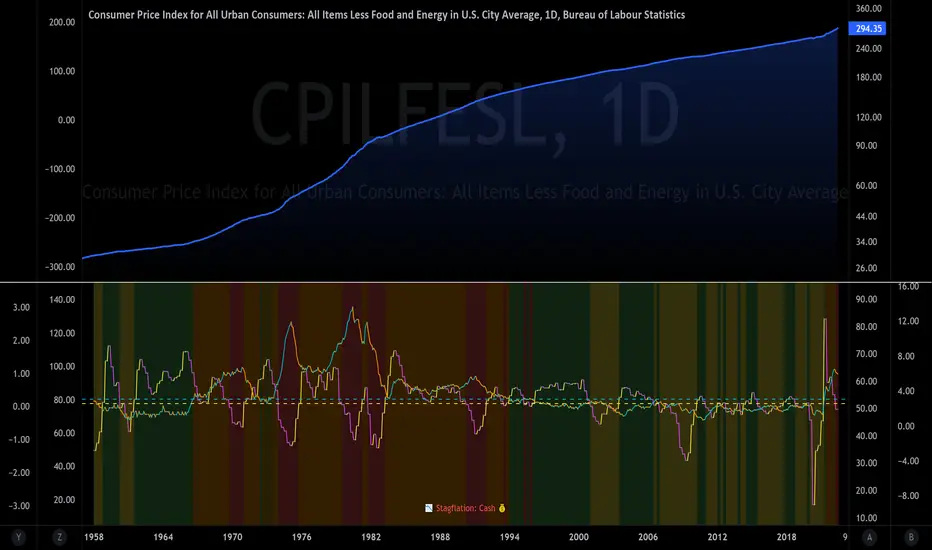
Gold and Bitcoin: The Evolution of Value!The Eternal Luster of Gold
In the dawn of time, when the earth was young and rivers whispered secrets to the stones, a wanderer named Elara found a gleam in the silt of a sun-kissed stream. It was pure gold, radiant like a captured star fallen from the heavens. She held it in her palm, feeling its warmth pulse like a heartbeat, and in that moment, humanity’s soul awakened to the allure of eternity.
As seasons turned to centuries, gold wove itself into the story of empires. In ancient Egypt, pharaohs crowned themselves with its glow, believing it to be the flesh of gods. It built pyramids that reached for the sky and tombs that guarded kings forever. Across the sands in Mesopotamia, merchants traded it for spices and silks, its weight a promise of power and trust.
Translation moment: Gold became the first universal symbol of value. People trusted it more than words or promises because it did not rust, fade, or vanish.
The Greeks saw in gold not only wealth but wisdom, the symbol of the sun’s eternal fire. Alexander the Great carried it across the continent, forging an empire of golden threads. Rome rose on its back, minting coins whose clink echoed through history.
Through the ages, gold endured the rush of California’s dreamers, the halls of Versailles, and the quiet vaults of modern fortunes. It has been both a curse and a blessing, the fuel of wars and the gift of love, whispering of beauty’s fragility and the human desire for something that lasts beyond the grave. In its shine, we see ourselves fragile yet forever chasing light.
The Digital Dawn of Bitcoin
Centuries later, under the glow of computer screens, a visionary named Satoshi dreamed of a new gold born not from the earth but from the ether of ideas. Bitcoin appeared in 2009 amid a world weary of banks and broken trust.
Like gold’s ancient gleam, Bitcoin was mined not with picks but with puzzles solved by machines. It promised freedom, a currency without kings, flowing from person to person, unbound by borders or empires.
Translation moment: Bitcoin works like digital gold. Instead of digging the ground, miners use computers to solve problems and unlock new coins. No one controls it, and that is what makes it powerful.
Through doubt and frenzy, it rose as a beacon for those seeking sovereignty in a digital world. Its volatility became its soul, a reminder that true value is built on belief. Bitcoin speaks to ingenuity and rebellion, a star of code guiding us toward a future where wealth is weightless yet profoundly honest.
Gold’s Cycles: Echoes of War and Crisis
In the early 20th century, gold was held under fixed prices until the Great Depression of 1929 shattered these illusions. The 1934 dollar devaluation lifted it from 20.67 to 35, restoring faith amid despair. When World War II erupted in 1939, gold’s role as a refuge was muted by controls, yet it quietly held its place as the world’s silent guardian.
The 1970s awakened its wild spirit. The Nixon Shock of 1971 freed gold from 35, sparking a bull run during the 1973 Oil Crisis. The 1979 Iranian Revolution led to a 1980 peak of 850, a leap of more than 2,000 percent, as investors sought safety from the chaos.
Translation moment: When fear rises, people rush to gold. Every major war or economic crisis has sent gold upward because it feels safe when paper money loses trust.
The 1987 stock crash caused brief dips, but the 1990 Gulf War reignited its glow. Around 2000, after the Dot-com Bust, gold found new life, climbing from $ 270 to over $1,900 during the 2008 Financial Crisis. It dipped to 1050 in 2015, then surged again past 2000 during the 2020 pandemic.
The 2022 Ukraine War added another chapter with prices climbing above 2700 by 2025. Across a century of crises, gold has risen whenever fear tested humanity’s resolve, teaching patience and fortitude through its quiet endurance.
Bitcoin’s Cycles: Echoes of Innovation and Crisis
Born from the ashes of the 2008 Financial Crisis, Bitcoin began its story at mere cents. It traded below $1 until 2011, when it reached $30 before crashing by 90 percent following the MTGOX collapse.
In 2013, it soared to 1242 only to fall again to 200 in 2015 as regulations tightened. The 2017 bull run lifted it to nearly 20000 before another long winter brought it to 3200 in 2018. Each fall taught resilience, each rise renewed belief.
During the 2020 pandemic, it fell below 5000 before rallying to 69000 in 2021. The Ukraine War and the FTX collapse of 2022 brought it down to 16000, but also proved its role in humanitarian aid. By 2024, the halving and ETF approvals helped it break 100000, marking Bitcoin’s rise as digital gold.
Translation moment: Bitcoin’s rhythm follows four-year halving cycles when mining rewards are cut in half. This keeps supply limited, which often triggers new bull runs as demand returns.
Every four years, it's halving cycles 2012, 2016, 2020, 2024, fueling new waves of adoption and correction. Bitcoin grows strongest in times of uncertainty, echoing humanity’s drive to evolve beyond limits.
The Harmony of Gold and Bitcoin Modern Parallels
In today’s markets, gold’s ancient glow meets Bitcoin’s electric pulse. As of October 17, 2025, their correlation stands near 0.85, close to its historic high of 0.9. Both rise as guardians against inflation and the erosion of trust in the dollar.
Gold trades near 4310 per ounce a record high while Bitcoin hovers around 104700 showing brief fractures in their unity. Gold offers the comfort of touch while Bitcoin provides the thrill of code. Together, they reflect fear and hope, the twin emotions that drive every market.
Translation moment: A correlation of 0.85 means they often move in the same direction. When fear or inflation rises, both gold and Bitcoin tend to rise in tandem.
Analysts warn of bubbles in stocks, gold, and crypto, yet optimism remains for Bitcoin’s growth through 2026, while gold holds its defensive strength.
Gold carries risks of storage cost and theft, but steadiness in chaos. Bitcoin carries volatility and regulatory challenges, but it also offers unmatched innovation and reach. One is the anchor, the other the dream, and both reward those who hold conviction through uncertainty.
Epilogue: The Timeless Balance
Gold and Bitcoin form a bridge between the ancient and the future. Gold, the earth’s eternal treasure, stands as a symbol of stability and truth. Bitcoin, the digital heir, shines with the spark of innovation and freedom.
Experts view gold as the ultimate inflation hedge, forged in fire and tested over centuries. They see Bitcoin as its digital counterpart, scarce by code and limitless in reach.
Gold’s weight grounds us in reality while Bitcoin’s light expands our imagination. In 2025, as gold surpasses $4,346 and Bitcoin hovers near $105,000, the wise investor sees not rivals but reflections.
Translation moment: Gold reminds us to protect what we have. Bitcoin reminds us to dream of what could be. Together, they balance caution and courage, the two forces every generation must master.
One whispers of legacy, the other of evolution, yet together they tell humanity’s oldest story, our unending quest to preserve value against time and to chase the light that never fades.
🙏 I ask (Allah) for guidance and success. 🤲
مؤشر Pine Script®
The Investment ClockThe Investment Clock was most likely introduced to the general public in a research paper distributed by Merrill Lynch. It’s a simple yet useful framework for understanding the various stages of the US economic cycle and which asset classes perform best in each stage.
The Investment Clock splits the business cycle into four phases, where each phase is comprised of the orientation of growth and inflation relative to their sustainable levels:
Reflation phase (6:01 to 8:59): Growth is sluggish and inflation is low. This phase occurs during the heart of a bear market. The economy is plagued by excess capacity and falling demand. This keeps commodity prices low and pulls down inflation. The yield curve steepens as the central bank lowers short-term rates in an attempt to stimulate growth and inflation. Bonds are the best asset class in this phase.
Recovery phase (9:01 to 11:59): The central bank’s easing takes effect and begins driving growth to above the trend rate. Though growth picks up, inflation remains low because there’s still excess capacity. Rising growth and low inflation are the Goldilocks phase of every cycle. Stocks are the best asset class in this phase.
Overheat phase(12:01 to 2:59): Productivity growth slows and the GDP gap closes causing the economy to bump up against supply constraints. This causes inflation to rise. Rising inflation spurs the central banks to hike rates. As a result, the yield curve begins flattening. With high growth and high inflation, stocks still perform but not as well as in recovery. Volatility returns as bond yields rise and stocks compete with higher yields for capital flows. In this phase, commodities are the best asset class.
Stagflation phase (3:01 to 5:59): GDP growth slows but inflation remains high (sidenote: most bear markets are preceded by a 100%+ increase in the price of oil which drives inflation up and causes central banks to tighten). Productivity dives and a wage-price spiral develops as companies raise prices to protect compressing margins. This goes on until there’s a steep rise in unemployment which breaks the cycle. Central banks keep rates high until they reign in inflation. This causes the yield curve to invert. During this phase, cash is the best asset.
Additional notes from Merrill Lynch:
Cyclicality: When growth is accelerating (12 o'clock), Stocks and Commodities do well. Cyclical sectors like Tech or Steel outperform. When growth is slowing (6 o'clock), Bonds, Cash, and defensives outperform.
Duration: When inflation is falling (9 o'clock), discount rates drop and financial assets do well. Investors pay up for long duration Growth stocks. When inflation is rising (3 o'clock), real assets like Commodities and Cash do best. Pricing power is plentiful and short-duration Value stocks outperform.
Interest Rate-Sensitives: Banks and Consumer Discretionary stocks are interest-rate sensitive “early cycle” performers, doing best in Reflation and Recovery when central banks are easing and growth is starting to recover.
Asset Plays: Some sectors are linked to the performance of an underlying asset. Insurance stocks and Investment Banks are often bond or equity price sensitive, doing well in the Reflation or Recovery phases. Mining stocks are metal price-sensitive, doing well during an Overheat.
About the indicator:
This indicator suggests iShares ETFs for sector rotation analysis. There are likely other ETFs to consider which have lower fees and are outperforming their sector peers.
You may get errors if your chart is set to a different timeframe & ticker other than 1d for symbol/tickers GDPC1 or CPILFESL.
Investment Clock settings are based on a "sustainable level" of growth and inflation, which are each slightly subjective depending on the economist and probably have changed since the last time this indicator was updated. Hence, the sustainable levels are customizable in the settings. When I was formally educated I was trained to use average CPI of 3.1% for financial planning purposes, the default for the indicator is 2.5%, and the Medium article backtested and optimized a 2% sustainable inflation rate. Again, user-defined sustainable growth and rates are slightly subjective and will affect results.
I have not been trained or even had much experience with MetaTrader code, which is how this indicator was originally coded. See the original Medium article that inspired this indicator if you want to audit & compare code.
Hover over info panel for detailed information.
Features: Advanced info panel that performs Investment Clock analysis and offers additional hover info such as sector rotation suggestions. Customizable sustainable levels, growth input, and inflation input. Phase background coloring.
⚠ DISCLAIMER: Not financial advice. Not a trading system. DYOR. I am not affiliated with Medium, Macro Ops, iShares, or Merrill Lynch.
About the Author: I am a patent-holding inventor, a futures trader, a hobby PineScripter, and a former FINRA Registered Representative.
مؤشر Pine Script®
TGS By ShadTGS Levels — Tesla–W.D. Gann Strategy
TGS Levels is a price-geometry indicator designed to map algorithmic decision zones on the chart using principles inspired by W.D. Gann price geometry and Tesla 3-6-9 harmonic structure.
This indicator is not a signal generator.
It provides a structured price map to help traders understand where reactions or breakouts are statistically more likely to occur.
🔹 Core Concept
Markets do not move randomly.
They rotate and expand around harmonic price cycles.
TGS Levels automatically plots a 100-unit price cycle framework (ideal for XAUUSD / Gold) and divides each cycle into hierarchical angles used by institutional and algorithmic trading models.
🔹 Level Hierarchy (Very Important)
TGS uses four types of levels, each with a different purpose:
🔴 SUPER ANGLE (+45)
Primary decision level
Price often shows strong rejection or explosive breakout
Highest importance level
🟥 MAIN ANGLES (+27, +63, +81)
High-probability reaction zones
Used for structured pullbacks, rejections, or continuation confirmation
🟠 SECONDARY ANGLES (+18, +36, +54, +72, +90)
Context & management levels
Expect hesitation, partial profit zones, or stop-tightening areas
Not recommended for direct entries
🟡 MICRO LEVELS (+3, +6, +9)
Liquidity & compression map
Help visualize absorption, stop hunts, and consolidation
For structure awareness only
🔹 What This Indicator Is Used For
✔ Identifying where price is likely to react
✔ Understanding market structure and rotation
✔ Distinguishing rejection vs breakout zones
✔ Improving trade timing when combined with:
Volatility (ATR)
Market structure (HL / LH / BOS)
Session timing (London / New York)
🔹 What This Indicator Is NOT
❌ Not a buy/sell signal
❌ Not a prediction tool
❌ Not based on indicators like RSI or MACD
TGS Levels is a price-first framework, designed to be used with price action, volatility, and structure.
🔹 Best Use Case
Asset: XAUUSD (Gold)
Execution Timeframe: M5
Sessions: London & New York
Style: Scalping / Intraday structure trading
The same logic can be adapted to other instruments by adjusting the cycle size.
🔹 How to Trade With TGS (High-Level)
When volatility is low or falling → expect rejections at main/super angles
When volatility is expanding → expect breakouts through angles
Use oscillators (like Stochastic) only for timing, not direction
Always confirm with price behavior at the level
🔹 Final Note
TGS Levels provides a clean, non-repainting price map that stays aligned when zooming or scrolling the chart.
All levels are calculated automatically and update dynamically with price.
Levels explain behavior — reactions create opportunity.
مؤشر Pine Script®
TGS By ShadTGS Levels — Tesla–W.D. Gann Strategy
TGS Levels is a price-geometry indicator designed to map algorithmic decision zones on the chart using principles inspired by W.D. Gann price geometry and Tesla 3-6-9 harmonic structure.
This indicator is not a signal generator.
It provides a structured price map to help traders understand where reactions or breakouts are statistically more likely to occur.
🔹 Core Concept
Markets do not move randomly.
They rotate and expand around harmonic price cycles.
TGS Levels automatically plots a 100-unit price cycle framework (ideal for XAUUSD / Gold) and divides each cycle into hierarchical angles used by institutional and algorithmic trading models.
🔹 Level Hierarchy (Very Important)
TGS uses four types of levels, each with a different purpose:
🔴 SUPER ANGLE (+45)
Primary decision level
Price often shows strong rejection or explosive breakout
Highest importance level
🟥 MAIN ANGLES (+27, +63, +81)
High-probability reaction zones
Used for structured pullbacks, rejections, or continuation confirmation
🟠 SECONDARY ANGLES (+18, +36, +54, +72, +90)
Context & management levels
Expect hesitation, partial profit zones, or stop-tightening areas
Not recommended for direct entries
🟡 MICRO LEVELS (+3, +6, +9)
Liquidity & compression map
Help visualize absorption, stop hunts, and consolidation
For structure awareness only
🔹 What This Indicator Is Used For
✔ Identifying where price is likely to react
✔ Understanding market structure and rotation
✔ Distinguishing rejection vs breakout zones
✔ Improving trade timing when combined with:
Volatility (ATR)
Market structure (HL / LH / BOS)
Session timing (London / New York)
🔹 What This Indicator Is NOT
❌ Not a buy/sell signal
❌ Not a prediction tool
❌ Not based on indicators like RSI or MACD
TGS Levels is a price-first framework, designed to be used with price action, volatility, and structure.
🔹 Best Use Case
Asset: XAUUSD (Gold)
Execution Timeframe: M5
Sessions: London & New York
Style: Scalping / Intraday structure trading
The same logic can be adapted to other instruments by adjusting the cycle size.
🔹 How to Trade With TGS (High-Level)
When volatility is low or falling → expect rejections at main/super angles
When volatility is expanding → expect breakouts through angles
Use oscillators (like Stochastic) only for timing, not direction
Always confirm with price behavior at the level
🔹 Final Note
TGS Levels provides a clean, non-repainting price map that stays aligned when zooming or scrolling the chart.
All levels are calculated automatically and update dynamically with price.
Levels explain behavior — reactions create opportunity.
مؤشر Pine Script®
TGS by Shad TGS Levels — Tesla–W.D. Gann Strategy
TGS Levels is a price-geometry indicator designed to map algorithmic decision zones on the chart using principles inspired by W.D. Gann price geometry and Tesla 3-6-9 harmonic structure.
This indicator is not a signal generator.
It provides a structured price map to help traders understand where reactions or breakouts are statistically more likely to occur.
🔹 Core Concept
Markets do not move randomly.
They rotate and expand around harmonic price cycles.
TGS Levels automatically plots a 100-unit price cycle framework (ideal for XAUUSD / Gold) and divides each cycle into hierarchical angles used by institutional and algorithmic trading models.
🔹 Level Hierarchy (Very Important)
TGS uses four types of levels, each with a different purpose:
🔴 SUPER ANGLE (+45)
Primary decision level
Price often shows strong rejection or explosive breakout
Highest importance level
🟥 MAIN ANGLES (+27, +63, +81)
High-probability reaction zones
Used for structured pullbacks, rejections, or continuation confirmation
🟠 SECONDARY ANGLES (+18, +36, +54, +72, +90)
Context & management levels
Expect hesitation, partial profit zones, or stop-tightening areas
Not recommended for direct entries
🟡 MICRO LEVELS (+3, +6, +9)
Liquidity & compression map
Help visualize absorption, stop hunts, and consolidation
For structure awareness only
🔹 What This Indicator Is Used For
✔ Identifying where price is likely to react
✔ Understanding market structure and rotation
✔ Distinguishing rejection vs breakout zones
✔ Improving trade timing when combined with:
Volatility (ATR)
Market structure (HL / LH / BOS)
Session timing (London / New York)
🔹 What This Indicator Is NOT
❌ Not a buy/sell signal
❌ Not a prediction tool
❌ Not based on indicators like RSI or MACD
TGS Levels is a price-first framework, designed to be used with price action, volatility, and structure.
🔹 Best Use Case
Asset: XAUUSD (Gold)
Execution Timeframe: M5
Sessions: London & New York
Style: Scalping / Intraday structure trading
The same logic can be adapted to other instruments by adjusting the cycle size.
🔹 How to Trade With TGS (High-Level)
When volatility is low or falling → expect rejections at main/super angles
When volatility is expanding → expect breakouts through angles
Use oscillators (like Stochastic) only for timing, not direction
Always confirm with price behavior at the level
🔹 Final Note
TGS Levels provides a clean, non-repainting price map that stays aligned when zooming or scrolling the chart.
All levels are calculated automatically and update dynamically with price.
Levels explain behavior — reactions create opportunity.
مؤشر Pine Script®